
Breaking the Offensive Glass Ceiling
How the Houston Rockets Built the Greatest Offensive Rebounding Team in History

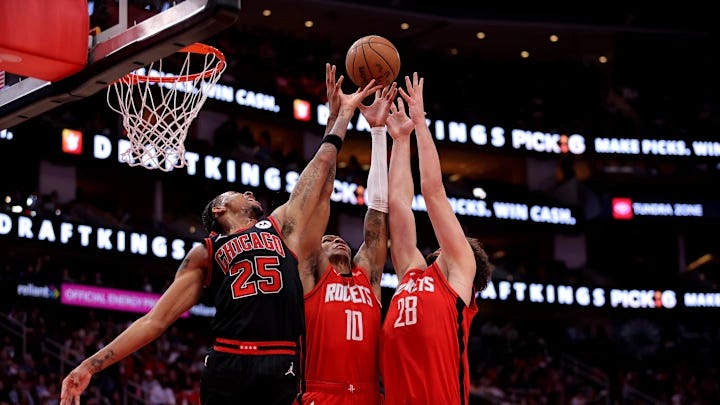
Offense is supposed to be sexy. Whether it’s a high-flying dunk, a step-back three, an ankle-breaking crossover, or a pass that straddles the line between illusion and reality, elite offense offers a glimpse of beauty and leaves the audience with a sense of child-like wonder. And then there are the Houston Rockets.
*All Stats as of December 2nd
The Rockets currently own the second-ranked offense in the league at 123.8 points per 100 possessions. However, that second rank obfuscates just how good they’ve truly been. The Nuggets’ 125.4 offensive rating would be the highest ever, with these Rockets just behind. In fact, since 1996-97, these Rockets have the tenth-highest offensive rating relative to the league average. Anyway you slice it, the 2025-26 Houston Rockets are one of the elite offenses in NBA history, yet they look nothing like an elite offense.
What Elite Offense is Supposed to Look Like
Dean Oliver, the Godfather of Basketball Analytics, identified the four factors of basketball success as shooting (eFG%), turnovers (TOV%), rebounding (ORB% & DRB%), and free throws (FT/FGA). Now, the four factors aren’t equally important. eFG% has a 40% weight, turnovers have a 25%, rebounding has a 20%, and free throws take up the remaining 15%. In general terms, elite offenses are almost always powered by elite shooting and butressed by excellence in one or two other areas.
Take the 2025-26 Nuggets, as an example. Their eFG% of 58.4% ranks second, their TOV% of 12.2% ranks sixth, their ORB% of 28.8% ranks eighth, and their FT/FGA of 0.242 ranks fifth in the league. Unsurprisingly, the greatest offense in NBA history excels in all facets of offensive basketball because that’s how great offense is supposed to work. However, the Rockets have thrown those conventions to the wayside to construct one of the most devastating attacks in league history.
This season, the Rockets rank 14th in eFG% (54.7%), 11th in TOV% (12.8%), seventh in FT/FGA (0.238), and first in ORB% (37.9%). Now, in most seasons, simply ranking first in offensive rebounding wouldn’t be enough to propel a team with such modest rankings in the other three factors to such heights. No, the Rockets aren’t simply the best offensive rebounding team in the league; they’re the best offensive rebounding team in (recorded) history.
Offensive (Rebounding) History
Dating back to 1973-74, the first season the NBA delineated between offensive and defensive rebounds, the 2025-26 Houston Rockets’ offensive rebound percentage of 37.9% ranks fifth out of 1,416 individual team seasons. Now, I know what you’re thinking: fifth isn’t first, and first means best, but that ignores one crucial component– the league environment.
League Average Offensive Rebound Rate
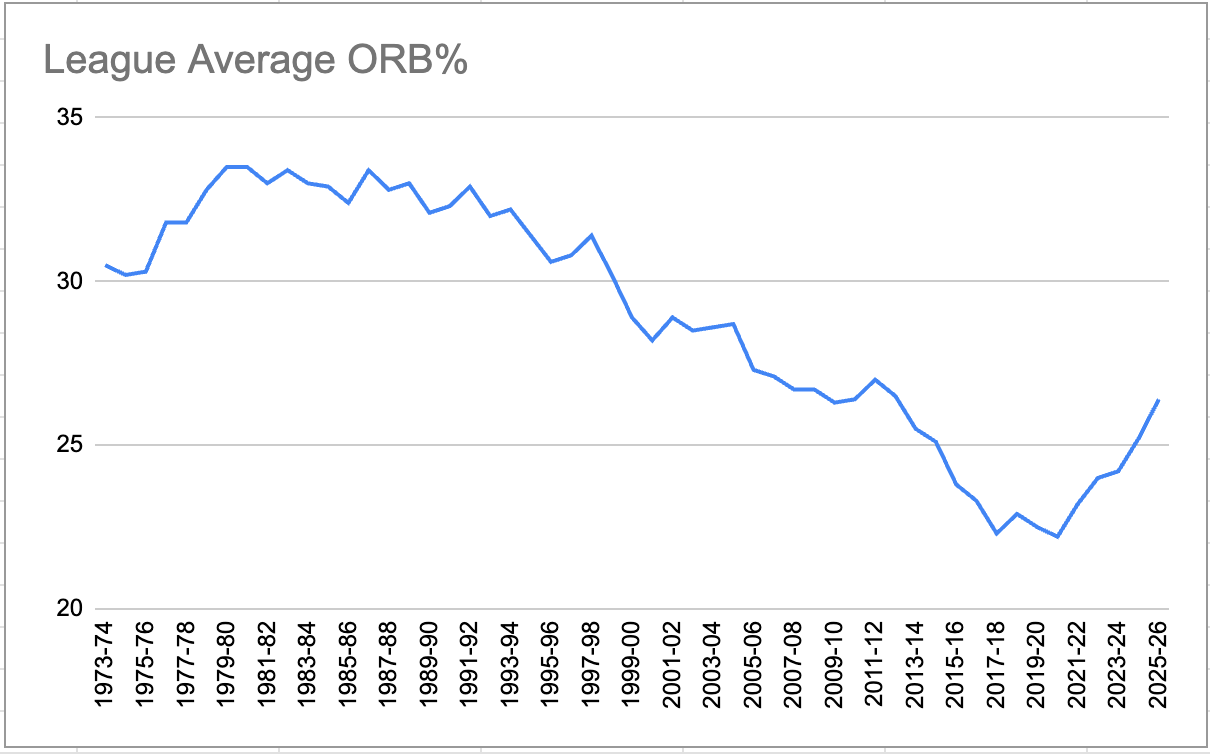
Since peaking in the 1980s, the league average offensive rebound rate has been trending down. While there has been a resurgence in recent seasons, we’re still miles off the heights seen throughout the ‘80s and ‘90s when the four teams above the Rockets in team offensive rebound percentage– the 1991-92 Nets, 1994-95 Mavericks, 1980-81 Warriors, and 1988-89 Sonics– all played.
To better represent how much of an outlier the 2025-26 Rockets are, I devised two simple metrics. First, I took every team’s offensive rebound rate, divided it by that season’s league average offensive rebound rate, and then multiplied that figure by 100 to create Adjusted Offensive Rebound Rate (ORB%+). The second is simply the individual Z-score for each team’s offensive rebound rate (ORB%-Z). And in these two metrics, the 2025-26 Houston Rockets are not only first; they’re first by a significant margin.
The Rockets’ ORB%+ of 143.56 is 12.89 points better than the second-place team, the 2015-16 Oklahoma City Thunder. The gap between the Rockets in first and the Thunder in second at 130.67 is the same as the gulf between the Thunder and the 2008-09 Philadelphia 76ers in 31st. Needless to say, the Rockets, in relation to the league average, are in a completely different stratosphere compared to the rest of NBA history.
All-Time Adjusted Offensive Rebounding Leaders
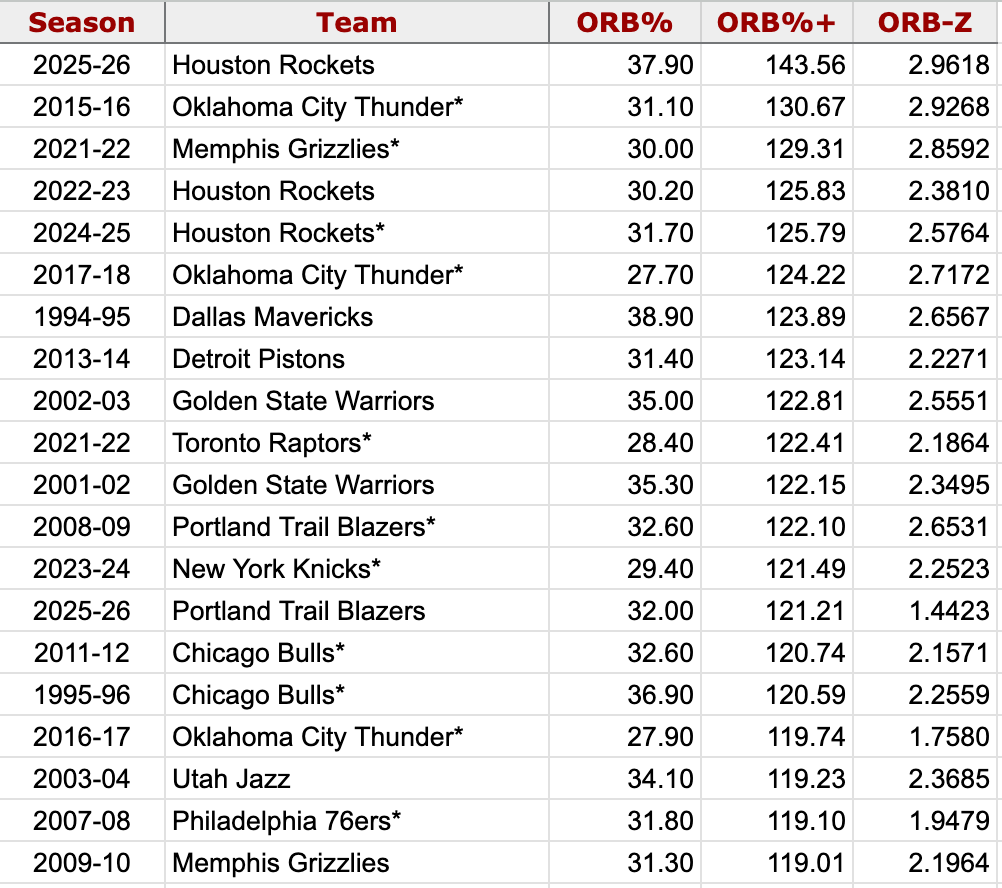
When it comes to Z-score, the 2025-26 Rockets are still first, but don’t own as much of an edge as you would think. Their 2.962 ORB%-Z is only fractions ahead of those same Thunder at 2.923. However, the 2025-26 standard deviation in ORB% is at an all-time high of 3.88%. Over the course of the season, as the sample grows, it’s likely that the variance in team offensive rebounding regresses towards the mean and narrows the standard deviation, which would in turn boost their Z-score.
The 2025-26 Rockets are showing just how powerful their outlier offensive rebounding is for offense. Even though offensive rebounding only explains 20% of offensive production, if you’re as good as the Rockets are, that 20% becomes a whole lot larger. The question for the Rockets is if they can maintain this outlier level of rebounding, or if regression is destined to drag them back to the pack. While usually I would err on the side of caution, these Rockets are designed to be the best offensive rebounding team in history.
How the Rockets Built the Greatest Offensive Rebounding Team in History
Prior to the arrival of Ime Udoka, Fred VanVleet, and Dillon Brooks to Houston in 2023-24, which sparked the franchise’s turnaround, the Rockets had already begun to lay the groundwork for what would become the most dominant offensive rebounding team in history.
Despite a 22-60 record and the league’s 27th-ranked offense, the 2022-23 Rockets led the league in offensive rebound rate. The combination of Alperen Sengun and Tari Eason, along with strong work on the offensive glass by their cohort of backup centers, powered the Rockets to a 30.1% offensive rebound rate, which, adjusted for league environment, is the fourth-best season in history.
Whether that initial success was happenstance or not, it’s clear the Rockets’ front office saw the value and opportunity to build an unstoppable rebounding machine. That offseason, they not only brought in Udoka and veteran stability but also drafted Amen Thompson, a wing/point guard who can rebound like a center. The 2023-24 Rockets would take a step back on the offensive glass, dropping to 25.1%, but they made a franchise-altering trade in the middle of the season.
On February 1, 2024, the Rockets traded Victor Oladipo and a second-round pick to the Memphis Grizzlies for Steven Adams. Adams would miss the entirety of the 2023-24 season recovering from PCL surgery in his right knee, but the move signaled the Rockets’ intent. These are the top six teams all-time in Adjusted Offensive Rebound Rate. Do you notice any commonality?
Six Degrees of Steven Adams
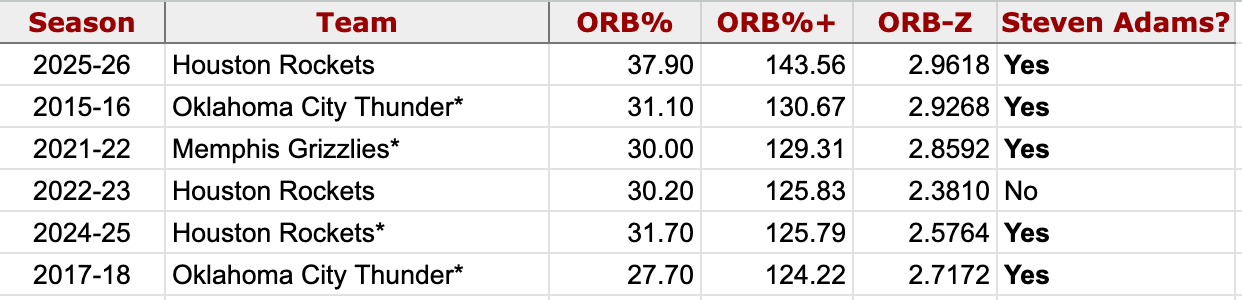
That’s right, the secret to being elite on the offensive glass is to employ Steven Adams, and the Rockets added him to the only roster in the top six that didn’t already have him. Honestly, Adams deserves an article all on his own, and I even wrote about his exploits for those 2021-22 Grizzlies. While Adams is only seventh all-time in individual offensive rebound rate at 15.24%, it’s clear his presence elevates his team’s to near-unprecedented levels.
Now, the Rockets aren’t simply killing teams on the offensive glass because of Adams. Alperen Sengun proved in 2022-23 to be dominant on the offensive glass, Tari Eason, when healthy, attacks the glass like a center, Amen Thompson is an elite positional rebounder, Jabari Smith Jr is 6’10, Kevin Durant is 7’0, Josh Okogie is one of the best rebounding shooting guards in the league, and they also went out and signed Clint Capela, owner of the fifth-highest career offensive rebound rate, this offseason.
Rocket Rebounders
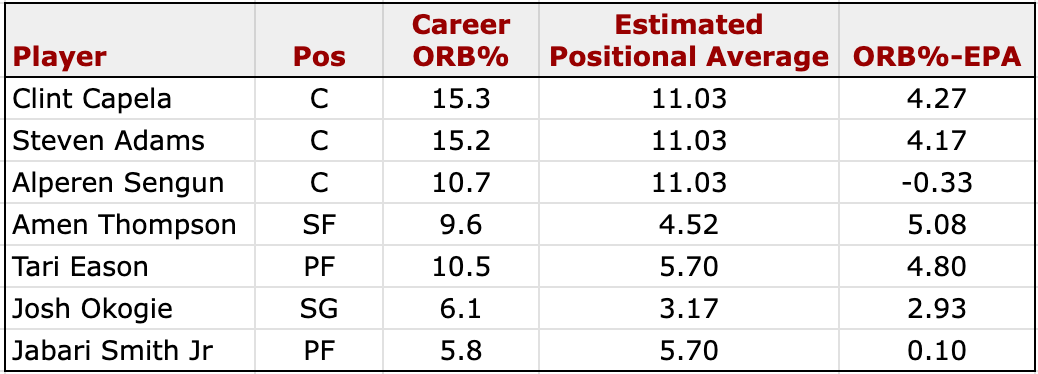
*Estimated Positional Average is the approximate positional ORB% average for the 2025-26 season
The intentionality with which the Rockets built their roster to prioritize offensive rebounding is simply incredible. While teams bend over backwards to land shooters and shot creators, the Rockets have quietly amassed an unparalleled arsenal of offensive rebounders. The offense isn’t always pretty, but as their 123.8 offensive rating can attest to, it is brutally effective.
What the Rockets are doing is in stark contrast to what conventional basketball wisdom had told us. Between 1979-80 and 2020-21, the linear correlation between league 3-point attempt rate and offensive rebound rate is -0.9547. The thought was that as 3-point rate increased, offensive rebounding would decrease, and since higher 3-point volumes lead to more efficient shooting, offensive rebounding would be continuously mitigated. However, over the past five seasons, 3-point attempt rate has continued to rise, as has offensive rebound rate.
This doesn’t prove a rebuke to the idea that 3-point volume and offensive rebounding aren’t inversely linked, but it does suggest something far more interesting. As the league became hyper-focused on shooting, teams began to undervalue the offensive glass. Back in 2021-22, I noticed that the Toronto Raptors and Memphis Grizzlies had top ten offenses, despite having abysmal team shooting efficiency. They were able to overcome this supposedly lethal shortcoming by crashing the offensive glass and protecting the ball. The truth is that the analytics were telling us that extra possessions could be just as valuable as improved shooting efficiency.
I believe we’re currently in a market correction phase for offensive rebounding. Teams invested so heavily in shooting that the cost to acquire it has begun to outpace its value. Meanwhile, teams largely ignored players who were exceptional on the offensive glass but deficient elsewhere, which made them much cheaper to acquire. And the Rockets took full advantage of this value gap. They got Adams as a salary dump and extended him on a three-year, $39 million deal. Alperen Sengun was the 16th pick. Tari Eason was the 17th pick. Clint Capela was signed to a three-year, $21.5 million contract. And Josh Okogie was picked up for the minimum. None of them were viewed as dangerous 3-point shooters, and as such, they were readily available for the Rockets to scoop up at market rate, which was well below their actual value.
The Rockets built the greatest offensive rebounding team in history because the rest of the league was either oblivious or apprehensive of its power. What likely started as happenstance quickly became a concerted effort to build the most ruthlessly efficient offense both on the court and financially. The Rockets’ willingness to trust their process and internal metrics should be commended. After years of the game being stretched to the perimeter, the Rockets are trying, and succeeding, at bringing basketball back to its bludgeoning roots.
For any inquiries about work, discussion, and the like, you can email me at nevin.l.brown@gmail.com.