
NBA Positional Player Rankings: Point Guards
The most definitive ranking of my opinions

We’ve done it. Well, actually, I’ve done it. At over 30,000 words deep and counting, we finally get to the final position in my positional player rankings– point guard. If you’d like to be rage baited over the length of a novella, here’s a link to each positional ranking below.
Centers
Power Forwards
Small Forwards
Shooting Guards
The point guard position is absolutely stacked. It far and away has the most talent of any position, and where a player ranks within the position group is much less important than the tier they occupy. For instance, the 16th-ranked point guard is in the third-star tier, while the 16th-ranked small forward, power forward, center, and shooting guard are all in tiers that amount to elite role players.
This point guard supremacy isn’t an accident. Over the past decade, teams have opted to shift their best offensive initiators, non-center division, to the position, and let them cook. Similar to the quarterback position in the NFL, teams have become increasingly open to varying skillsets, as long as they lead to points. The ramifications of this have amounted to the NBA equivalent of brain drain. It’s not so much that we’re better at producing point guards than ever; it’s that we’re better at letting people play point guard, so long as it leads to efficient offense. Reminder, positions are based on Basketball Reference’s positional classifications. Now, let’s rank some guards.
Top-30 Point Guards
Honorable Mentions
Jose Alvarado: New Orleans Pelicans
As the point guard position has evolved to include more varied characters, players who would have been nominal starters 25 years ago have been pushed into reserve roles. It might be fantasy, but I get the sense that Larry Brown would have gone to war to make sure Alvarado was his table-setting starting point guard who defended his ass off. Alvarado is about as far from a star as can be, but what he brings to the court will never go out of style. Over the past two seasons, Alvarado has proven to be a relatively consistent 3-point shooter (36.6%) and owns a 3:1 assist-to-turnover ratio (3.4:1.1). That’s not starter material in today’s NBA, but when you pair it with some of the peskiest defense in the league, the result is a really useful player. Alvarado is a player you love to have as a bench option because he can run with starters if the matchup demands it, but he’s also capable enough to run a second unit and terrorize lesser ball handlers. His ability to seamlessly create lineup advantages is why he owns a +5.8 on-off net rating.
Dennis Schroder: Sacramento Kings
Americans need to begrudgingly accept that Dennis Schroder will be a member of the basketball Hall of Fame. His international accolades are second to none, and outside of an Olympic Gold, he has done and won everything. However, we’re talking about the NBA, not international ball here. Schroder occupies an interesting spot in the NBA. He’s an exceptional backup point guard, but isn’t quite good enough to be a starter for a team with playoff aspirations. If you exclude his rookie season, the percentage of games that Schroder comes off the bench has a 0.655 linear correlation to his on-court net rating. This isn’t rigorous analysis, but it paints a clear picture of when and where Schroder’s contributions are most valuable. On offense, Schroder is a low-efficiency scorer who passes and protects the ball well enough to keep things humming, and on defense, he is a strong point of attack defender. The biggest thing preventing him from being a low-tier starter is his 3-point shot. As a career 34.2% 3-point shooter, he provides negative floor spacing off the ball and allows teams to go under screens in the pick-and-roll.
Dejounte Murray: New Orleans Pelicans
Calling Dejounte Murray’s 2024-25 season the season from hell would be an understatement. He played one game, broke his hand, came back five weeks later, was objectively awful, and then tore his Achilles. To add insult to injury, the guy the Pelicans traded him for won Most Improved Player, made the All-Defense first team, and finished second in Defensive Player of the Year voting. So, yeah, some worries, bro. The odd part of Murray’s offensive collapse was that it came in stark contrast to the player he had become. Over the course of his career, he had gone from a defense-first guard to a legitimately good shooter and offensive orchestrator. His offensive and defensive skills were like ships passing in the night, but in 2020-21, the two vectors collided, and he earned an All-Star nod as one of the better two-way point guards in the league. Following his breakout, he was traded to the Hawks, and while his defense continued to decline, his offensive growth more than made up for it. During his two-season stint in Atlanta, he shot 35.5% from three, 49.4% on long-twos, 48.6% on shots ten to 16 feet, and 45% on shots three to ten. Then, last season, he collapsed to 29.9% on threes, 28.9% on long-twos, 46.1% on 10-16, and 34.9% on 3-10. Unsurprisingly, his effective field goal percentage was a dismal 44.5%, the lowest of his career, and it would have been the lowest in the NBA if he had played enough games to qualify. I don’t think 2024-25 was truly representative of his talent, but a decline of that magnitude, combined with an Achilles tear, pushes him out of the top-30 for me. Hopefully, he can come back healthy and approximate the player he was before, but I’m not optimistic he’ll ever regain the form that made him an All-Star.
Miles McBride: New York Knicks
I’m not sure if McBride is a real point guard, but he’s a solid 3-and-D player who just happens to be the size of a point guard. Honestly, there’s not that much more to it. He can really shoot threes; he’s at 38.8% on 7.1 attempts per 36 minutes over the past two seasons, and he can actually defend the ball. Unsurprisingly, the Knicks’ offense and defense were better with McBride on the court last season, and it raises the question of whether he should start next to Jalen Brunson. Regardless, McBride is a great depth piece to have. He accentuates your best lineups and can pilot your reserves to respectability. McBride is further proof that you can never have too much shooting and defense from your role players.
Role Player Table Setter
30. D’Angelo Russell: Dallas Mavericks
I’m sure D’Angelo Russell would have something to say if he saw himself ranked as the 30th-best point guard, and that’s precisely the reason he’s the 30th-ranked point guard. Russell is exceptionally talented compared to the entire NBA population, which he knows, but not so much compared to all point guards, which he doesn’t. He’s a good 3-point shooter, but not a great one. He can run the pick-and-roll, but he’s no maestro. He can handle the ball, but isn’t dynamic on it. And the less said about his defense, the better. This combination of offensive qualities allows him to shoulder a relatively high usage. Unfortunately, he’s not quite good enough as a lead initiator that any team trying to win would want that, and due to his defensive limitations, as his usage dwindles, so does his utility. Functionally, Russell would be a super valuable player if winning 35 to 42 games was beneficial, but since no one (except the Bulls) wants to do that, he’s either soaking up possessions on awful teams or a frustrating role player on good ones. This season, he’ll frustratingly do a bit of both for the Mavericks, and then find himself somewhere else repeating the D’Angelo-cycle.
29. Lonzo Ball: Cleveland Cavaliers
People forget, but the Chicago Bulls were first in the Eastern Conference before Ball’s knee disintegrated, eventually necessitating a cartilage transplant. Ranking Ball this high is all about what he’ll do on a per-minute basis. As a general rule, you don’t want to be the first person in a professional sport to come back from a particular surgery, but Ball has done just that. It took him two years away from basketball, but he finally returned in 2024-25 and looked largely the same player. The beauty of Ball’s game is that he is basically a 3-and-D wing with the passing of a point guard. After dismal 3-point shooting in his first two seasons, he overhauled his mechanics and has shot 38.1% on 8.2 attempts per 36 since 2019-20. His off-the-dribble game was never up to NBA point guard standards, but he’s an adept ball handler who will create advantages through incredible passing in place of breaking down defenders. On defense, Ball is an excellent off-ball defender who leverages his length and IQ to overcome a lack of athleticism. The biggest concern will always be health. Even before his career-threatening knee injury, Ball had maxed out at 63 games played in a season, and the Cavaliers are likely to use him judiciously. Despite never having played in the playoffs, Ball is a winning player, and I expect the Cavaliers’ best lineups to feature him. I’m hoping he can stay healthy because basketball is better with Lonzo Ball.
28. Mike Conley: Minnesota Timberwolves
There’s a real chance Mike Conley is cooked. He turned 38 a week ago, averaged the lowest points per game of his career (8.2) last season, and has seen his defense decline enough that it’s a question whether he’s even neutral on that end anymore. As much as that’s all true, I don’t care because he still drives winning. Crucially, Conley can still shoot the three-ball (41%), and his top-notch decision-making is one of those skills that the box score usually misses, but the scoreboard never does. Over the course of an 18-season career, Conley has an on-court net rating of +3.3 and an on-off net rating of +5.1. Last season, he had an on-court net rating of +6.2 and an on-off rating of +2.1, and in the playoffs, it was +7.5 (on-court) and +9.2 (on-off). I’ll admit, this could be it for Conley. He wouldn’t be the first professional athlete to crash and burn in their late 30s, but I still believe he will be a crucial factor for a Timberwolves team trying to make a third consecutive Conference Finals.
27. Chris Paul: Los Angeles Clippers
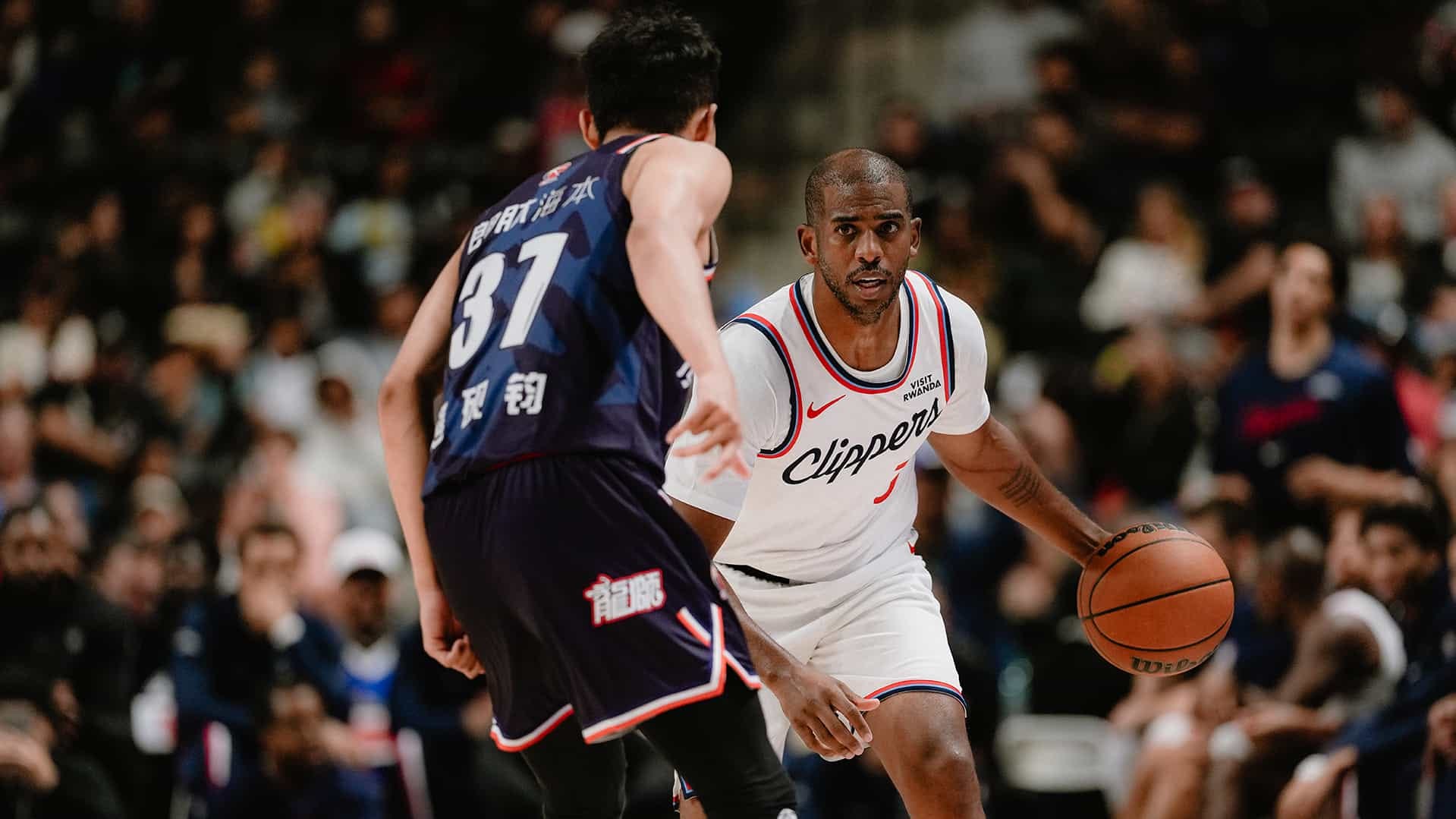
Pretty much everything I just wrote about Mike Conley applies to Chris Paul. In year 20, Paul, for the first time in his career, played all 82 games. This is one of the greatest point guards of all time, and despite declining athleticism, his combination of skill and IQ still makes him a winning player. While his on-court net rating of -1.3 was his first negative on-court net rating since 2006-07, he still posted an on-off net rating of +3.9, and if it weren’t for Victor Wembanyama’s injury, he probably would have ended the season in the black. In 1,152 minutes together, Wembanyama and Paul led the Spurs to an on-court net rating of +6.14. Even though his scoring has deteriorated substantially, his ability to set up teammates and limit turnovers remains elite. Last season, his assist-to-turnover ratio of 4.7:1 was the fifth-best mark in the league among the 347 players who played more than 500 minutes. I have no idea how the Clippers’ point guard rotation will play out, but what I do know is that they’ll win their minutes when Paul is on the court.
26. TJ McConnell: Indiana Pacers
This is probably far too high a ranking for McConnell. He’s the rare point guard who does not shoot threes, his defense has started to decline, and he’s going to begin the season out with a hamstring injury. For a bench player who will turn 34 in March, a top-30 ranking is almost certainly too high, but at the same time, have you ever seen him play? McConnell will literally dominate a game for five consecutive minutes. It’ll start with a backcourt steal, then he’ll roast his defender and nail a fading short mid-range jumper on three consecutive possessions, and he’ll top it all off by stealing the inbounds and dishing to Obi Toppin for a monstrous dunk. There aren’t many players who can just punch a game in the face like that, and it’s made all the more hilarious because he’s a short white guy who looks deeply uninterested in ever shooting a three. Honestly, if McConnell ever had a real 3-point shot, he could have been a borderline All-Star. For his career, he has attempted 1.2 threes per 36 minutes. That makes Mark Jackson look like Steph Curry. Despite all my trepidations over this ranking, McConnell produces on the court.
25. Tyus Jones: Orlando Magic
Tyus Jonicus, the patron saint of assist-to-turnover ratio, has established himself as the most overqualified backup point guard in the league. For his career, he owns a 5.4:1 assist-to-turnover ratio, is a 37.8% 3-point shooter, and has committed only 84 lost ball turnovers in his career, a figure four players eclipsed last season (Cade Cunningham: 105, James Harden: 97, Anthony Edwards: 95, Jalen Green: 85). I cannot stress this enough: turnovers are the worst. They guarantee zero points and lead to increased offensive efficiency for the opposition. Doing back-of-the-envelope math, a single turnover is at least a 2.3 point swing. If you want steady, mistake-free point guard play, with a little bit of 3-point shooting, you can’t do much better than Jones. Now, Jones’ one weird trick, not turning the ball over, can’t completely make up for his main deficiency– he’s short and unathletic. This lack of height and/or burst makes him a significant liability on defense, inefficient within the arc, and prevents him from attacking defenses off the dribble. As a complementary offensive piece, Jones is great, but a point guard is supposed to be the main dish. There is tremendous value in having a player like Jones, but he’s just too limited to be a high-level starter, although he’s an excellent backup.
24. Scotty Pippen Jr: Memphis Grizzlies
While writing this blurb, I learned Pippen would undergo toe surgery and be reevaluated in 12 weeks, which sucks because he has become a very good player. As a side note, his father, Scottie Pippen, unofficially changed the spelling of his name from Scotty to Scottie because he found people would shorten Scotty to Scott but not Scottie. Fortunately for Junior, Scottie’s fame made any such shenanigans unnecessary. Anyways, Scotty Pippen Jr joins the Grizzlies’ ever-growing list of unheralded players who prove to be quality NBA players. Over the past two seasons, he has played 100 games, averaged 10.5 points, 4.5 assists, and 1.4 steals per game on 58.6% True Shooting (TS%), played solid defense, and kept the Grizzlies afloat through multiple Ja Morant absences. In fact, his production when he has started is one of the reasons he’s ranked so highly. Last season, in 21 starts, he averaged 14.2 points, 5.7 assists, 4.5 rebounds, and 1.7 steals on an eFG% of 61%, and guided the Grizzlies to a 12-9 record. In the playoffs, he started all four of the Grizzlies’ games and scored 28 and 30 points in games three and four. There’s some hot 3-point shooting boosting his numbers, but the reality is Pippen proved he’s a starting-caliber point guard last season. With how sporadically available Morant has been in the recent past, the Grizzlies were banking on Pippen being an exceptional deputy. It’s rare to say this about a backup, but his injury could end up derailing the Grizzlies should Morant suffer an early-season injury.
Happy to Have, Easy to Move on From
23. CJ McCollum: Washington Wizards
CJ McCollum, entering his 13th NBA season, is on a streak of ten consecutive seasons averaging 20 or more points per game, and there’s no good reason that streak should end. Now, I specified “good reason” for a reason. Over the summer, McCollum was traded to the Wizards for Jordan Poole and Sadiq Bey, and there’s a decent chance his minutes will be limited to lose as many games as possible through the justification of providing their young guards on-ball reps. Hopefully, the Wizards allow McCollum to have the role he deserves as their lead point guard, let him get buckets, and then either trade or buy him out so he can join a real NBA team. McCollum’s advanced age, 34, provides some cause for concern, but he’s still one of the best jump shooters in the league and is a steady distributor. The main reason he’s marooned on the Wizards is that his defense is severely negative, and he’s not quite good enough on-ball to run a high-level offense. I think this could be the final year where McCollum is a starter, but he should have a few seasons as a dynamite sixth man for contenders. However, if he wants to keep starting, he’s definitely good enough, but bottom-third teams are loath to play veterans just to win a few extra games.
22. Immanuel Quickley: Toronto Raptors
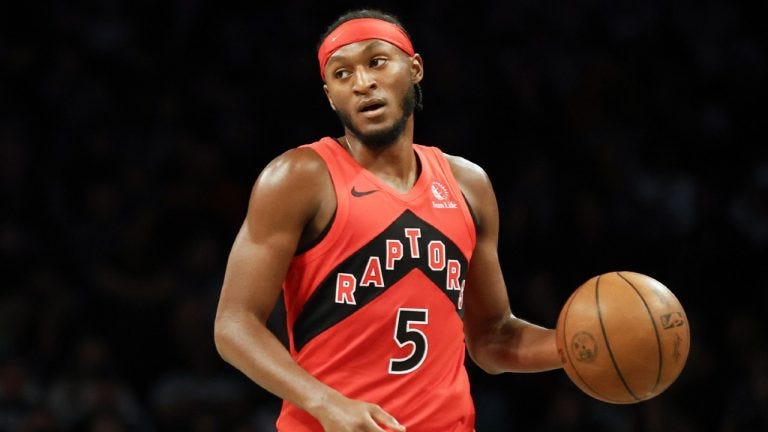
It feels like the NBA world has forgotten about Immanuel Quickley. He first made a name for himself as a crucial piece of the Knicks’ resurrection under Tom Thibodeau. In three and a half seasons in New York, Quickley was one of the best Sixth Men in the NBA, averaging 12.9 points and 3.0 assists per game while playing solid defense off the bench. He might not have been the face of the Knicks, but his on-court net rating of +7.3 and on-off net rating of +9.2 over that span suggest he was one of their most important players. Then he was traded to Toronto for OG Anunoby, and that was the last anyone has heard of him. Now, Quickley’s vanishing act is mainly a result of Americans’ impressive ability to pretend that Toronto is some backwater podunk hamlet not worthy of even the slightest thought, when it’s actually the fourth-largest city in North America, behind Mexico City, New York City, and Los Angeles. So, what has Quickley been up to north of the border? Well, first of all, he’s now a starter, and, when not injured, he’s been pretty dang good. In 71 games with the Raptors, he has averaged 17.9 points, 6.3 assists, and 4.2 rebounds on a TS% of 56.7%, and his offensive BPM comes in at 2.4, the same figure Austin Reaves produced last season. Defensively, Quickley isn’t a lockdown on-ball stopper, but he knows how to leverage his size to be better than your run-of-the-mill point guard. The Raptors and Quickley are heading into the season healthy, and I think there’s a good chance he reminds everyone just how good he is by being just as good as he always was.
21. Kris Dunn: Los Angeles Clippers
Kris Dunn might have been the best defender in the league last season. He led the league in defensive BPM, Neil Paine’s Raptor, and Dunks and Threes estimated plus/minus among players to play over 1,500 minutes. If you are dribbling a ball, he makes your life hell. If you as much as look at a ball, Kris Dunn suddenly appears. It doesn’t matter if it’s a soccer ball, tennis ball, baseball, or Magic 8-Ball, he’ll chase you down like a rabid retriever. The Clippers had the third-best defense in the league because they were able to put Dunn on the ball and Zubac on the block. I know Jeff Van Gundy got a ton of praise for being their defensive architect, but it’s hard to fuck up a basilica when you’ve got marble and Michelangelo. Honestly, I could go on for ages about Dunn’s perimeter defense. He does it all. He glides through screens like a bad fart, guards up and down the positional spectrum, rips the ball from your hands, shoots passing lanes, and does any other superlative you can think of. I hate to do this, but as much as Dunn is the league’s premier defensive point guard, he is also an abysmal offensive player. He’s a low-usage, inefficient scorer who has had fleeting few moments of solid passing. In the modern game, it’s really hard to get so little offense from the guard position. The defense is game-breaking enough that Dunn is still a starting-caliber player, but it’s situational, and unfortunately, that situation probably isn’t the playoffs.
20. Payton Pritchard: Boston Celtics
The NBA’s reigning Sixth Man of the Year might have a hard time defending his crown, but that’s a good thing if you’re starting. Payton Pritchard had one hell of a season. He averaged 14.3 points per game on an eFG% of 62%, and shot 40.7% from three on 9.9 attempts per 36 minutes. I don’t know if you’ve heard, but efficient volume 3-point shooting is kind of a big deal, and he paired it with 64.2% shooting on twos. Now, Pritchard’s scoring efficiency is almost certainly going to come down. His TS% of 63.3% was fractions off of Shai Gilgeous-Alexander for tops among point guards, and Alexander is himself coming off a historically good scoring season. With all of the roster churn the Celtics have gone through, his volume is almost certainly going to increase, and the best way to mute efficiency is to crank up the volume. However, when you establish this high a baseline, you have a long way to go before you’re in the red. The scoring is undoubtedly the selling point, but it’s not the only thing he brings to the table. Pritchard, all 6’1 of him, is hilariously a very good offensive rebounder. Among point guards, his 4.9% offensive rebound rate was third, behind only Josh Giddey and Russell Westbrook. Instead of skying over defenders for putbacks, he just has a knack for finding the ball. Part of it is a willingness to crash the boards, but there are just some players who have a preternatural gift for sensing where the ball will land. On defense, due to his size, Pritchard is somewhat limited. However, he’s no pushover, and he’ll put the work in on that end. We’ll see how impactful that tryhard energy is on a much depleted defensive roster, but when surrounded by studs, he can be a strong weak link. I think Pritchard has shown enough that he’s clearly a low-level starting option at point, who also has the skills to seamlessly enhance his team off the ball. That role variability is crucial for a player who is never going to be the man.
19. Josh Giddey: Chicago Bulls
The stench of the Bulls’ crap has clouded people’s perception of Josh Giddey. He just turned 23, has fantastic positional size, is a passing wizard, and absolutely stuffs the statsheet. Yet, when he signed a four-year, $100 million contract, people couldn’t help but make jokes. I hate to break it to everyone, but $25 million for Josh Giddey in 2028-29, when he’ll be 26, has the potential to be an absolute bargain. The standout skill is the passing. Giddey owns an assist percentage of 30.4% and has averaged 9.2 assists per 36 minutes across his young career. Considering he has maxed out at 24.6% single-season usage, that’s mighty impressive, and his natural inclination to whip hit ahead passes only aids his team’s offensive output. The secondary skill is the size. Giddey is giant for a point guard. Listed at 6’8, his overwhelming height provides access to passing lanes that his more vertically challenged peers will never see. It also allows him to be one of the best positional rebounders in the game. Last season, his 6.4% offensive rebound rate was tops among point guards, and his 21.4% defensive rebound rate was second. The two areas where Giddey lags behind are in scoring and defense. While a lack of burst and bend will always limit his ability to create advantages off the dribble, his scoring has seen steady improvement. He’s coming off a career-best 37.8% showing from beyond the arc, and while I’m dubious that’s his new level, he has improved his 3-point efficiency each season, so I wouldn’t rule it out either. Giddey hasn’t shown much feel for a mid-range jumper, but he’s efficient in the floater range (45.3%), which could pair nicely with his passing in the pick-and-roll. The biggest flaw in his game is his rim finishing. Giddey owns a career field goal percentage of 63.9% zero to three feet from the basket, and is coming off a career-worst season where he shot 58.4%. At 6’8, with an inconsistent jumper, he simply needs to be more efficient near the basket. The good news is that at 6’8, that’s more likely to develop as he adds strength and craft. Finally, Giddey’s defense is not good, but I also think his limitations are a bit overstated. He’s a point guard, but he’s power forward-sized. So, yes, he can’t defend elite on-ball creators, but his size and rebounding make it so you can hide him one through four. If you’re a bad defender, the most important trait to possess is the ability to be hidden. At the end of the day, Giddey is a 23-year-old who has continuously improved and possesses a tantalizing combination of size and vision. I doubt he’ll ever be able to single-handedly lead an elite offense, but he can lead a fine offense, right now, which means he’s pretty good, right now.
18. Jalen Suggs: Orlando Magic
I am very concerned about Jalen Suggs, which sucks, because he’s an absolute menace when healthy. On March 2, Suggs underwent surgery to remove a cartilage fragment from his knee. The procedure, known as a mosaicplasty, moves a person’s healthy cartilage and/or bone to repair a damaged area. The Magic were optimistic he would make a full recovery, and while no official timetable was placed on his rehab, it was believed it would sideline him for several months. Well, it’s late October, and based on the reporting, it doesn’t seem likely that he’ll be ready for opening night. According to a Yahoo! article from October 17th, Suggs had yet to do 5-on-5 work, and “Suggs said one of the last hurdles that remains is the ability to fully stop while moving at full speed. ‘It’s really just that — being explosive and stopping out of explosiveness, which are just things you need to protect yourself out there,” he said. “Once we got all that established, the hardest part has just been watching everybody else hoop, to be honest. Harder than letting everything else coming together physically.’” Hopefully, Suggs and the Magic are being overly cautious in preparation for a long season, but I am not super stoked to read any of this. Suggs is a disciple of the Alex Caruso basketball dojo. His game is predicated on intensity. He’s an on-ball hound who stops ball handlers in their tracks, while also generating defensive events (steals, blocks). He’s in the running for best defensive point guard and has come to epitomize the Magic’s defensive identity. Elite defense is why he’s on the court, and without it, he’s nothing more than a reserve. Offensively, Suggs looks like he is coming off a horrible season, but that’s because he was forced into an offensive role far greater than his capabilities. Due to injuries, Suggs only played five games with both Franz Wagner and Paolo Banchero, and in those games, he averaged 16.8 points and 4.0 assists per game on a 63.5% TS%. Then Banchero got injured, Suggs became their secondary initiator, and over the next 19 games, he averaged 15.2 points and 3.9 assists on a TS% of 52.3%. And then Wagner got injured, and over the final ten games of his season, he averaged 18.6 points and 3.1 assists per game on a TS% of 52.3%. Suggs is grossly miscast as a primary creator, but he can be efficient in a low usage offensive role. Hopefully, with health, he can get back to being the best 3-and-D point guard in the league.
17. Jrue Holiday: Portland Trail Blazers
It took him being traded two times to Portland, but Jrue Holiday is finally set to make his Trail Blazers’ debut. Following Jayson Tatum’s Achilles injury, the Celtics spent the offseason operating with the brutal efficiency of a machete-wielding accountant, and Holiday was their first casualty, but Portland being the destination struck me as odd. The Trail Blazers have a young point guard in Scoot Henderson who needs reps, are already on excellent defense, and desperately need offensive creation. While Holiday is still an effective player, his skillset doesn’t address any of their pressing needs, and how well he’ll fit in Portland in the short and long term remains a mystery. One of the reasons the Celtics’ title defense ultimately came up short was that Holiday took serious steps back on offense. He paired the dreaded combination of reduced usage and efficiency, producing his worst offensive season in over a decade. Now, Holiday was always going to see a drop in 3-point efficiency. In 2023-24, he shot a career-high 42.9% from three and a “I cannot believe this is real” 61.9% from the corners. Unfortunately, his 3-point shot cratered to 35.3% and 30.2% from the corners. Holiday should see his shooting land somewhere in between those figures, but he’s not really a floor spacer, and I have no idea how much on-ball juice he still has at 35. Defensively, he’s not quite as elite as he used to be, but he’s still very much a plus. Last season, the Blazers finished with the 16th-ranked defense, and the addition of Holiday, along with player development, should easily see them as a top ten unit, with a real shot of landing in the top five. Holiday is no longer an All-Star-level player, but his on-ball defense and steady offense have kept him a winning player. He might not be what the Blazers need, but he should still make them better.
Third Star
16. Fred VanVleet: Houston Rockets
Unfortunately, VanVleet will miss the season following a torn ACL suffered during a workout in the Bahamas. This is not only a bummer for VanVleet, it’s a huge letdown for the Rockets. After the offseason addition of Kevin Durant, the Rockets looked like real title contenders, but VanVleet’s injury has likely knocked them down a rung. I’m not the president of the FVVFC, but I sure as hell appreciate how good he is. VanVleet excels at everything you need from a modern point guard. He’s a super steady distributor who limits turnovers, a high-volume 3-point shooter, and a fantastic on-ball defender. In fact, his impact on team turnover rate is an underrated superpower.
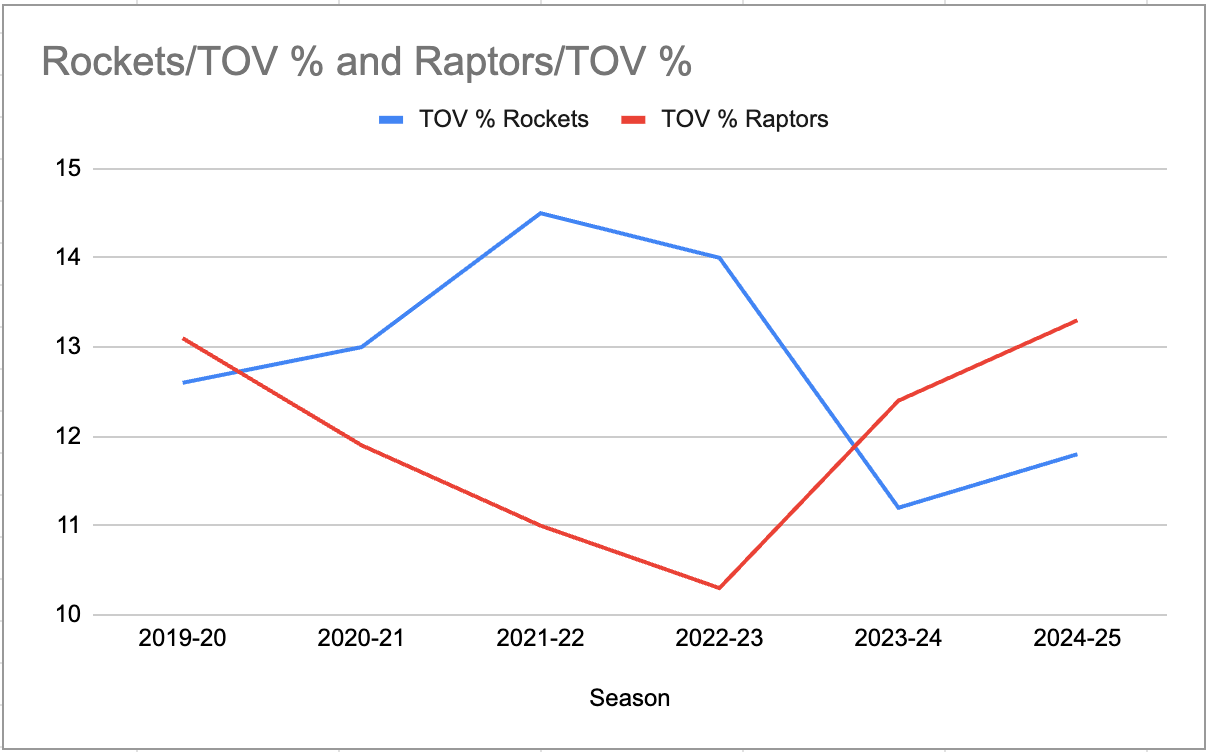
Take a guess when VanVleet changed teams. Yep, you nailed it, 2023-24. The Raptors went from having the lowest turnover rate in the league in 2022-23 to 18th in 2023-24, while the Rockets went from 29th to fifth. Unsurprisingly, the Raptors’ offensive efficiency plummeted from 115.5 to 112.3 without VanVleet, while the Rockets’ soared from 111.4 to 114.5. I’ll say this ad nauseam: turnovers are bad, and players who can limit them are super valuable. VanVleet isn’t just a steady ball protector. His 3-point shooting is a real weapon. While his seasonal 3-point efficiency can fluctuate, he’s almost always near or above 40% on catch-and-shoot opportunities, and since 2021-22, the majority of his threes have been classified as pull ups. This ability to bomb off the dribble allows him to play above his size and athleticism as an on-ball initiator. He’s not an elite pick-and-roll or isolation scorer, but he’s far more dangerous than the likes of Tyus Jones. However, the differentiator is that VanVleet is actually a good defender. I have no idea where he ranks as a screen navigator, but he’s certainly better at fighting through screens than most. He’ll stick to his man through thick and thin, and despite his size, he’ll rack up a surprising amount of blocks that are really just misclassified strips. Stars bend their teams in their image for the better. VanVleet might not look, or even play, like a player who does, but every team he’s on protects the ball, competes on defense, and wins.
15. De’Aaron Fox: San Antonio Spurs
At the point guard position, few players have been more productive than De’Aaron Fox as a scorer. Over the past five seasons, he has averaged 24.8 points per game on a TS% of 56.9%. He’s a quick-twitch initiator who uses his talents to get into the teeth of the defense and punish them from within. Quietly, he has developed into a very efficient scorer within 16 feet, and particularly within ten, shooting 74.4% on shots zero to three feet from the basket and 54.4% on shots three to ten since 2022-23. The bread and butter of his game, like so many scoring guards, is the drive. Last season, his 15.2 drives led to 10.1 points per game, with both figures ranking eighth. Fox’s ability to get into a defense and then score forms the backbone of his game. However, it kinda, sorta forms all of his game. He’s a career 33% 3-point shooter, and despite his ability within the arc, he’s only at league-average efficiency on twos over the past five seasons. Now, if Fox were an elite free throw generator, this would be an excellent overall scoring package, but his career free throw attempt rate (FTAr) of .324 is not enough to offset a below-average 3-point attempt rate. In practice, Fox gives you volume scoring at just under league-average efficiency. That’s a rare and valuable skill set, but to be a true offensive force, he would need to be an elite passer, which he is not. For his career, he has averaged 6.1 assists and 2.7 turnovers per game. Those are fine figures, but for a player who has the ball as much as he has, they’re a bit underwhelming. Basically, Fox scores the same amount of points as a lot of stars, but he doesn’t generate offense at a star level. On defense, he’s not a total mark, but he’s also almost certainly an overall negative. There’s a chance some of the issues Fox has are a result of less-than-ideal surroundings in Sacramento. Fortunately, he’s now in San Antonio and has Victor Wembanyama to play off of. If he can’t up his production with Wemby, then this is just his level.
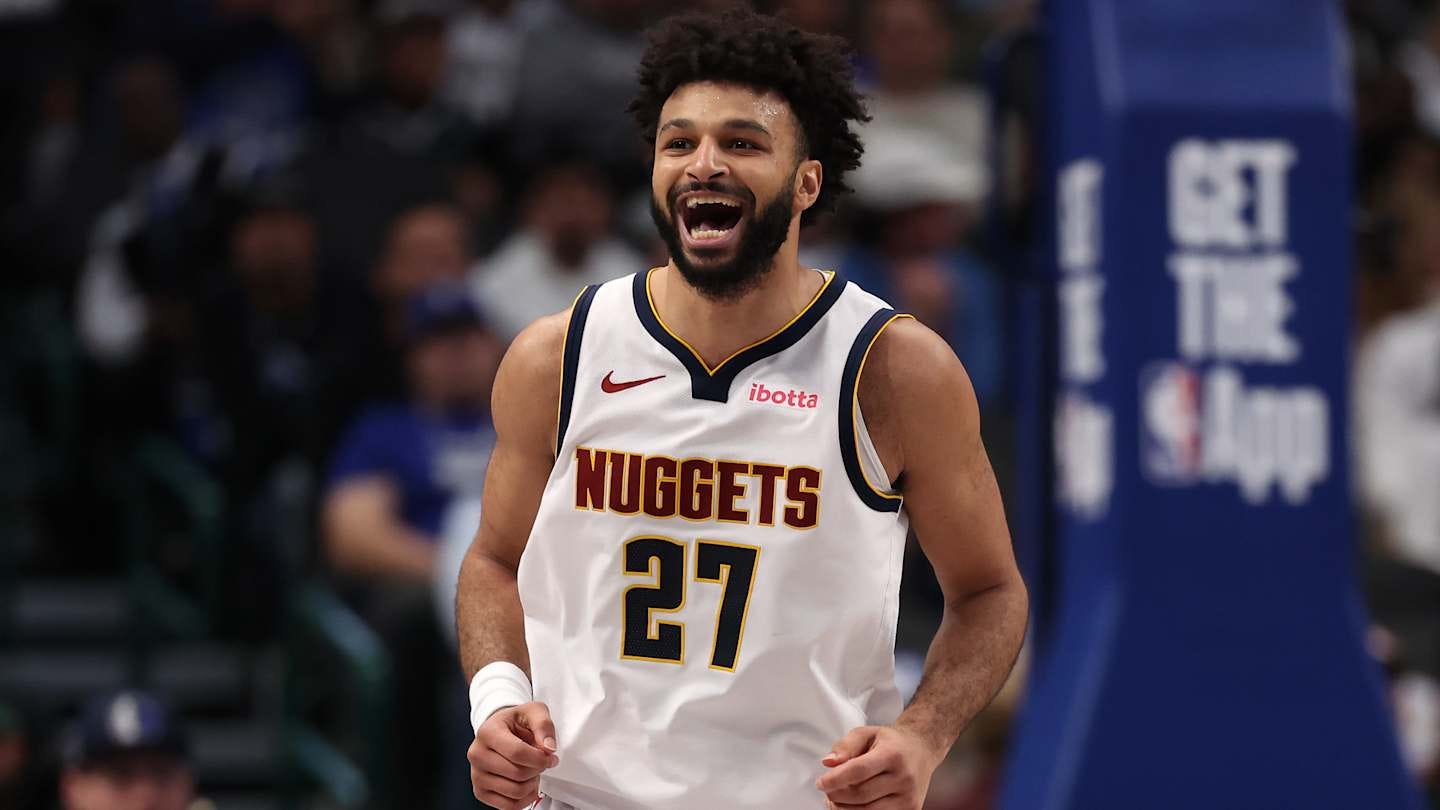
14. Jamal Murray: Denver Nuggets
2024-25 was decidedly a down year for Jamal Murray. He went from averaging 21.2 points, 6.5 assists, and 2.1 turnovers per game in 2023-24 to 21.4 points, 6.0 assists, and 2.1 turnovers per game in 2024-25. Wait, that doesn’t seem so bad. Well, I left out the most important statistic. Murray may have replicated his 2023-24 per-game averages, but it took him 36.1 minutes per game to do it, as opposed to 31.1. Even though 2024-25 was below his recent standard, there’s reason for optimism heading into this season. Murray’s overall line is dragged down by a god awful first half, but he looked to remedy whatever was ailing his game to close the season.

Virtually every team would take his second-half combination of production and efficiency, and it’s right in line with his production between 2020-21 and 2023-24 when you factor in his minutes load and usage. While Murray is the Nuggets’ second star, his production and impact are more in line with an excellent third banana. Due to Nikola Jokic being a seven-foot point guard, his offensive load is significantly lower than most high-level guards. Among all point guards, his usage ranked 17th, but his TS% was only just above the league average. Part of that is due to the role he occupies in the Nuggets’ offense, but the reality is he takes so many tough shots because he can’t generate easier ones. At the end of the day, the Jokic-Murray partnership works, but Murray isn’t a secret number-one option who has to sacrifice production for the good of the team. He’s a third option who looks like a secondary creator because he gets to play off the greatest offensive player in history.
13. Damian Lillard: Portland Trail Blazers
When Damian Lillard returns to an NBA court, he’ll be 36 years old, and he won’t be ranked 13th. However, I wanted to give an All-Time great player the flowers he deserves, not for his career accomplishments, but for the player he was right up until his Achilles snapped. Lillard’s time in Milwaukee will be viewed as a disappointment. And from a team perspective, that’s fair. The Bucks acquired him to make another championship push, and they failed to advance past the first round. However, laying the blame at Lillard’s feet is willful ignorance. Over two seasons in Milwaukee, he averaged 24.6 points, 7.0 assists, and 2.7 turnovers per game on a TS% of 60.4%. And while that represented a decline from his line of 28.4 points, 7.4 assists, and 2.9 turnovers per game on a TS% of 61.3% in his prior five seasons in Portland, it also completely ignores the reality that he was 33 and 34 playing next to another ball-dominant star. Lillard largely gave the Bucks exactly what they should have expected: elite but declining offensive creation. The biggest issue the Bucks ran into was their woeful roster construction. They had no perimeter defense, something Lillard has always been a negative at, and were one of the least athletic teams in the league. On top of that, the partnership between Lillard and Giannis Antetokounmpo never really got off the ground, but that’s more on Giannis, if you ask me. Lillard was an elite spread pick-and-roll operator. You trade for him to run pick-and-rolls and your opponent into the ground. Giannis does not love setting screen after screen and rolling to the rim. He’ll do it, but he much prefers to be the ball handler, get the ball at the top of the key, or attack from the wing or post. Instead of remedying the situation, the Bucks largely defaulted to a my turn, your turn approach to offense. It worked well enough, but with their defensive limitations, they needed their offense to be unstoppable. I was hoping Lillard would get a real shot to make a few deep runs with the Bucks, but fate conspired against him. He’s now back in Portland rehabbing, and hopefully, he’ll have a dignified end to his career.
12. James Harden: Los Angeles Clippers
In year 16, James Harden led the Clippers to the playoffs, made an All-NBA team, and continued to prove he is one of the greatest offensive players in history. I understand all of his playoff shortcomings, and while overstated a tad, at some point, you’d think he would screw up and have a moment in an elimination game. Regardless, Harden continues to do three things incredibly well: grift for free throws, create in the pick-and-roll, and show up to work. Since 2021-22, Harden has failed to produce even a league-average eFG%, but his elite ability to generate free throws means his TS% has been in the black. He may not look like an efficient scorer, but he still is, and with Kawhi Leonard starting the season healthy, I expect him to experience an efficiency bump. As a passer, Harden is a masterful pick-and-roll maestro. His pocket pass is unrivaled and might have surpassed his step-back three as his most identifiable move. For all the jokes about Harden being out of shape and perusing strip clubs, the man shows up to work and plays heavy minutes. Last season, his 2,789 minutes played were the fifth-highest figure in the league. Harden doesn’t have the most varied of attacks, but he’s a master at spamming the classics. He’ll do a bullshit rip through to get to the line, a step-back to create a three, and a pocket pass to a roller, and then he’ll do it again, and again, and again, and it mostly works. Defensively, Harden is good at not being a serious problem. Due to his strength, he can hide on larger players, and he’ll never miss an opportunity to switch out of a tough assignment. At the end of the day, Harden is still an awesome player. He’s no longer one of the league’s most dangerous offensive engines, but he knows how to generate points and get out of the way on defense.
Lead an Offense, But Second Star
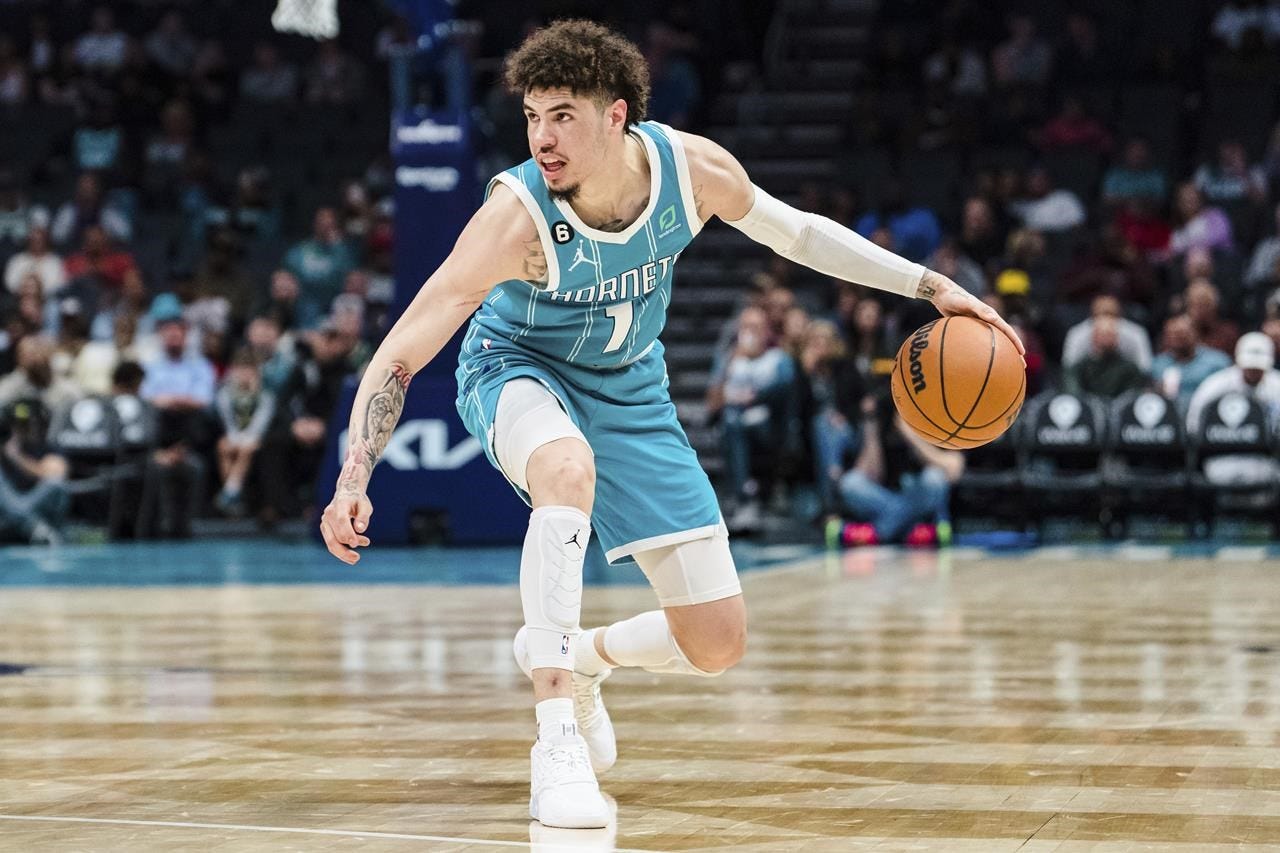
11. LaMelo Ball: Charlotte Hornets
Give me all of the LaMelo Ball memestock. Every time I write about the man, I feel like I have to defend his basketball honor because so much of the analysis is aesthetics-based. Yes, he has the dumbest fucking tattoos ever. Yes, he comes across as a pilled-out SoundCloud rapper. Yes, it sounds like he is at war with the English language when he speaks. Yes, he does some of the wildest shit you will ever see. But guess what? He’s really good at basketball, and that’s what should matter. However, the LaMelo take that grinds my gears the most is when people call him a losing player. It’s an awful take. Somehow, he’s simultaneously a player who needs to stay healthy and also the reason the Hornets are bad. I’m not a big QB wins person, but just look at the QB wins.
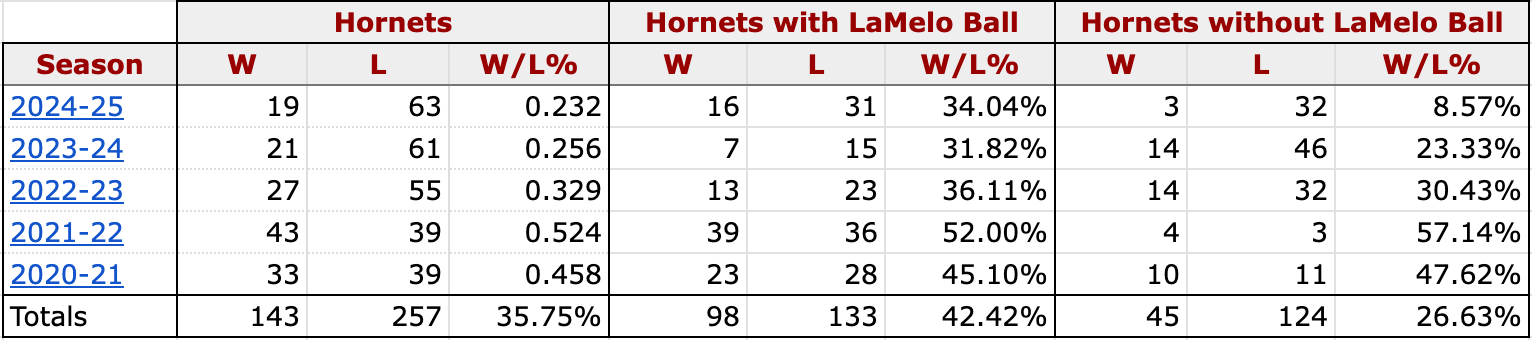
Last season, the Hornets went 16-31 in games where LaMelo played, and three, THREE, THREE!, 3-32 when he didn’t. Obviously, the Hornets need LaMelo to get and stay healthy, but he’s not the reason they’re awful; he’s the only reason they’ve even sniffed 20 wins the past two seasons. So, what is it about his game that actually impacts winning? Well, it’s the passing and insane high-volume 3-point shooting. Over the past four seasons, Ball has averaged 22.5 points, 9.3 3-point attempts, 7.8 assists, and 6.0 rebounds per game on a TS% of 54.6%. While you’d hope for better shooting efficiency, a lot of his shooting inefficiencies are usage-based (31.3%), and his combination of passing and floor spacing completely changes the Hornets’ offense. With Ball on the court over the past four seasons, the Hornets have posted a 115.2 offensive rating, but that figure has cratered to 107.7 without him. Functionally, Ball’s inefficiency leads to better offense, and if he were surrounded by more competent players, his efficiency would likely improve. Now, despite the tattoos, it’s not all gumdrops and rainbows in LaMelo land. He’s a poor defender, his decision-making can be erratic, his in-arc craft needs to improve, and he has to stay somewhat healthy. However, despite all of the flaws, he has still been wildly productive. I’m banking on LaMelo playing over 60 games with a more competent supporting cast and the NBA world doing a bunch of think pieces about how much more mature he is now. Ball can be a championship-level point guard because players this good, this young, almost always are.
10. Ja Morant: Memphis Grizzlies
The past two seasons have been trying for the Grizzlies and Ja Morant. From 2021-22 through 2022-23, the Grizzlies, led by Ja Morant, won 107 games and looked poised to challenge for titles. Then injuries and suspensions hit, limiting Morant to 59 total games, as the Grizzlies slumped to 75 wins over the next two seasons. While Morant’s availability has been the primary issue, his play has also taken a step back.

Morant has still been a good player, but he hasn’t looked like a real superstar since 2022-23. The biggest concern is that his field goal attempt rate on shots zero to three feet has declined every season of his career. Morant’s superpower was his ability to get downhill and to the rim, and from there, he was an elite finisher, but most crucially, an excellent passer. His scoring efficiency has always hovered around league average, which is fine at his usage, but the separating skill was his ability to generate a ton of assists. Last season, his assist percentage dropped to 36%, down from a high of 41.1% in 2022-23. A lot of that had to do with the Grizzlies’ shift away from the pick-and-roll. In 2022-23, Morant averaged 12.8 pick-and-roll ball handler possessions, but that figure was nearly cut in half to 6.9 in 2024-25. The Grizzlies’ aversion to the pick-and-roll should change this season, as their very public late-season coaching change can attest. Honestly, I’m in wait-and-see mode with Morant. He’s still a valuable player, but he wouldn’t be the first hyper athletic small guard who looked like the next face of the league in their early 20s, only to decline rapidly right as they should be entering their prime. I think we’ll see a statistical bounce-back for Morant as the Grizzlies get back to a bread-and-butter pick-and-roll attack, but the ship may have sailed on him being a true superstar already.
9. Darius Garland: Cleveland Cavaliers
There’s a real case that Darius Garland was the Cavaliers’ best guard last season. I know Donovan Mitchell got all the awards, but under the hood, Garland had an equally impressive season. He averaged 20.6 points, 6.7 assists, and 2.5 turnovers per game on a 60% TS% as the Cavaliers outscored their opponents by +10.3 points per 100 possessions with him on the court. While this was a career year for Garland, it wasn’t actually all that much better than the level he established in 2021-22 and 2022-23 when he averaged 21.6 points, 8.2 assists, and 3.3 turnovers on a 58.1% TS%. As a note, I’m pretty much throwing out his 2023-24 season. He played 57 games but missed six weeks from mid-December to February with a broken jaw, and lost 12 pounds from a wired mouth and a liquid diet. In three out of the past four seasons, Garland has looked like one of the better young point guards in the league. He’s a lethal 3-point shooter (39.2%), strong passer (7.4 assists per game), and efficient in the floater (45.1%) and mid-range (52%). Garland is just entering his prime; he won’t turn 26 until January, and I think he could lead a top ten offense as the lone perimeter engine. For as much of a fan as I am of Garland’s, he does present some limitations. His lack of size and strength makes him a negative defender, prevents him from being a scoring threat around the basket, and requires a screen to be at his best off the dribble. None of these are fatal flaws, but they make it much harder for me to envision him ever jumping up a tier. However, maxing out as an All-NBA adjacent player is still very valuable.
8. Cade Cunningham: Detroit Pistons
It took a while, but Cade Cunningham finally had the season prospect evaluators envisioned when he went first overall in the 2021 NBA draft. He averaged 26.1 points, 9.1 assists, and 6.1 rebounds per game, took home All-NBA third team honors, and led the Detroit Pistons to their first playoff victory since the Pleistocene (2007-08). As a tall lead guard (6’6), Cunningham is a threat all over the court and can contribute in every phase of the game. There’s a lot to like, but there’s also a lot Cunningham needs to improve on if he’s ever going to level up. The biggest thing holding him back is efficiency. Cunningham has yet to post a TS% at or above the league average, and his 4.4 turnovers per game last season are problematic. The easiest way for him to improve this season is to cut the turnovers. His 105 lost ball turnovers led the league, and his 173 bad pass turnovers were third. Just taking those down a bit would be huge for his offensive impact. As for the shooting efficiency, the cleanest avenue for him to improve is to become a better 3-point shooter. He’s already a decent mid-range jump shooter, suggesting there is real shooting touch, and his lack of burst and rim finishing makes it hard for me to believe getting downhill more is the more viable option. A more potent 3-point shot would boost his efficiency, but also open up more driving lanes and space, further enhancing its effect. As great looking as 26.1 points and 9.1 assists are, they were mostly a product of massive usage, but that’s not a serious concern. Cunningham just turned 24 and has shown consistent growth. I don’t think he’ll get beyond this tier because there just isn’t enough special in his passing or scoring package, but he’s so well-rounded, he’ll have no problem helping a contender, even if he’s the second option.
7. Trae Young: Atlanta Hawks
I’m not going to say that Trae Young is the best passer in the league, but I will say that he’s the most productive. In three of the past four seasons, he has led the league in points generated by assists (PGA), and last season, his 2,031 was the first 2,000 PGA season since James Harden in 2016-17. If anyone is going to eclipse 12.0 assists per game for the first time since John Stockton in 1994-95, it’s going to be Trae Young. Young has firmly established himself as one of the best high-volume passers in the league, but that’s not the only thing he does. Over the past six seasons, he has averaged 26.5 points per game on a TS% of 58.5%. While Young is often compared to Steph Curry, his scoring splits are much more reminiscent of James Harden. He’s a relatively average 3-point shooter, well below league average within the arc, but uses his free throw generating mastery to get to league-average efficiency. When you add volume scoring at league average efficiency to the highest volume passer in the league, you get yourself a high-level offensive player. Despite Young’s insane offensive production, there is one trend that I’ll be looking into this season– can he still produce elite team offense?
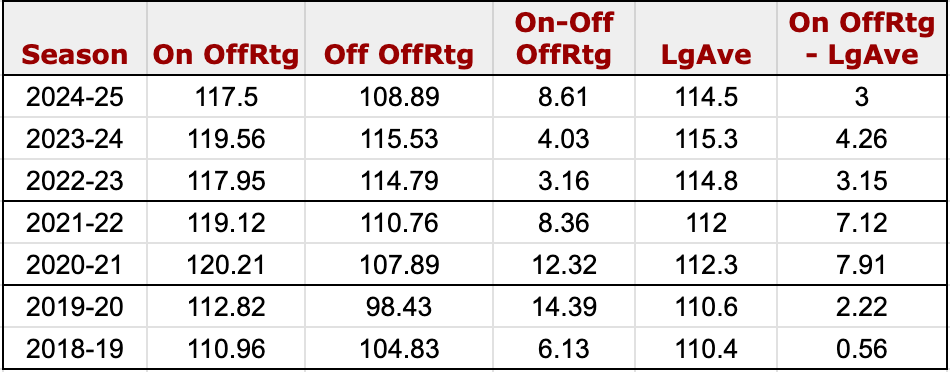
At Young’s peak, he was regularly guiding the Hawks to absurd offensive efficiency relative to the league average, and while he’s still been able to get the Hawks in the air, they’re not soaring quite as high as before. This could simply be due to shifting personnel, but if Young isn’t leading the Hawks to a top-tier offense when he’s on the court, that’s a bit of a problem because his defense is on the opposite end of the spectrum. Trae Young is unequivocally the worst defender in the league. He is small. He is not particularly fast. He is weak. And, worst of all, everyone knows it. The Hawks understand this and have surrounded him with a stable of strong defenders. In a weakened Eastern Conference, the Hawks and Young have their best opportunity to make a deep run. If they can’t even muster an excellent regular season, I’ll have to move Young down, but I’m expecting him to be a monster on offense and lead the Hawks to 50+ wins.
6. Tyrese Maxey: Philadelphia 76ers
Based solely on accomplishments, I might be a little too high on Maxey, but sometimes you’ve got to do a little projecting. Over the past four seasons, he has averaged 22.2 points and 5.0 assists per game on an eFG% of 53.6% and 38.6% 3-point shooting, and increased his scoring each season. When a player is young, productive, and keeps getting better, it’s hard to expect anything other than improvement as they head into their age-25 season. While last season he set a new career-high in points per game at 26.3, it did come at the cost of efficiency. However, there’s a big catch here. All of Maxey’s efficiency decline was due to an uncharacteristically poor 3-point shooting season (33.7%), as he set new career-highs in 2-point efficiency (51.5%) and free throw shooting (87.9%). With an improvement towards his career norms from beyond the arc, Maxey looks poised to have a monster season because he possesses the single most powerful skill in the game. Despite the explosion in 3-point rate, getting to the basket is still the best thing a player can do, and there’s a real argument that Maxey is the best in the league among point guards. Last season, his 22.6% field goal attempt rate zero to three feet from the basket was 17th among all players classified as point guards who played over 500 minutes, and he was one of two point guards with a greater than 20% 0-3 feet field goal attempt rate and 40% 3-point attempt rate. What makes this so impressive is that it doesn’t even take into account the absolute dumpster fire season the Sixers had that left Maxey functionally staring for the Delaware Blue Coats. With a far more functional roster around him and another year of development, I’m expecting Maxey to score over 25 points per game on an above league-average efficiency. When you factor in his solid passing and a relatively low turnover rate, you’re left with at least a top-20 offensive player who is just entering their prime.
Build an Elite Team Around
5. Jalen Brunson: New York Knicks
There’s no better existence than being a star in New York City, and unlike Los Angeles, where you’re competing with the entertainment industry, professional athletes are at the top of the food chain. New Yorkers love their teams like your grandmother loves grandchildren. And if you bring them happiness, they’ll shower you with adoration till the end of time. So, when Jalen Brunson takes a team-friendly deal, maybe he’s just playing four-dimensional chess, because bringing a title to the Knicks is worth something money can’t buy. Now, to do that, he’ll need to put in the hard yards on the court, but luckily for him, he’s pretty dang good on the hardwood. There’s not a ton of complexity to Brunson’s game. He’s an incredible three-level scorer who can get to his spots, pivot like a squashed cartoon Hakeem Olajuwon, and then hit tough jumper after tough jumper. Is it the prettiest style of basketball? Not for me, but if you love My Hero Ball Academia, it might be the best show in town. Since arriving in New York, Brunson has 26.4 points, 6.7 assists, and 2.3 turnovers per game on a TS% of 59.8%, and established himself as a top ten offensive creator. There is nothing more valuable than a high-level offensive initiator. They’re why teams tank, clear out cap space two years in advance, and burn every last pick imaginable. If you want to win a title, they’re a necessity. It’ll be interesting to see if Brunson’s role changes now that Mike Brown is the coach. My guess is it’ll look different, but coaches aren’t stupid. You want your best offensive player touching the ball, which means Brunson’s fingerprints will be all over the Knicks’ offense. On defense, Brunson is a liability. He isn’t a good point of attack defender, is too small to have much versatility, and he’d rather not fight through a screen. However, he is in a blood feud with Lu Dort as the most elite offensive foul grifter in the league. That doesn’t make him a good defender, but it helps boost him from the bottom in my eyes. Regardless, when a player is this good on offense, the defense just doesn’t matter that much.
4. Steph Curry: Golden State Warriors
What more can be said about Stephen Curry that hasn’t already been said by Andre Iguodala? Like, seriously, the glaze is out of control. However, Iguodala is right to be mighty complimentary of one of the greatest shooters in NBA history because the man is about as dangerous an offensive player as the league has ever seen. To this day, Curry’s 10.3 offensive BPM in 2015-16 remains the highest single-season mark since 1973-74. While he’s not at that level anymore, the secret sauce to “longevity” is being so fucking good that you can get worse for a long time and still be amazing. So, what does Curry look like a decade later? Well, he’ll score 25 points a game on 40% 3-point shooting and a 60% TS%, comically high figures for a high-usage guard. He’ll also sling between five and six assists and just about three turnovers, of which 33% will be on the most needlessly insane pass you will ever see. For as great a shooter as Curry is, his behind-the-back passes are as accurate as a Russell Westbrook pull-up triple. However, the statistics don’t do justice to his offensive impact. The Warriors became a juggernaut when Steve Kerr decided that having the most dangerous shooter in existence run around the court like a madman was actually the secret to breaking basketball. Five titles later, he might have been onto something. Curry’s non-stop off-ball movement warps defense away from the ball and the basket, which allows the rest of the team to feast on favorable matchups, uncontested cuts, and defenders who are more scared of the terrorists in Pakistani mountain caves than the white nationalists next door. We’re over a decade into this charade, and still no one has any answers. As age has begun to creep up, Curry isn’t quite as dangerous as he used to be, and his defense has decidedly become negative. He’s still one of the ten best players in the world, but he isn’t the cheat code he was in his prime. All that means is instead of being title favorites, the Warriors are just in the mix.
3. Tyrese Haliburton: Indiana Pacers
Tyrese Haliburton was 48 minutes from basketball immortality. The Pacers’ 2025 playoff run was one of the most exciting in NBA history, and at the center of all the magic was Haliburton. His basketball ethos ran through the whole roster’s veins as they overcame insurmountable deficits, unbeatable opponents, and hit unthinkable shots. Haliburton and the Pacers gave basketball fans the greatest of all gifts: they made you feel. In defiance of the odds, they had forced a game seven with the Oklahoma City Thunder, owners of the best point differential in NBA history. For seven minutes in the seventh game, Haliburton made the Pacers look the Thunder’s equal, and then we were reminded just how mortal we all are. When Haliburton went down, writhing in pain, we all knew what we had seen. We knew he was done, and so were the Pacers’ chances. There’s never a good time to tear your Achilles, but I’d argue game seven of the NBA Finals is the absolute worst. Hopefully, Haliburton will be able to come back and be the player he was because the lowest-common-denominator NBA fan had only just realized his greatness. Over the past three seasons, Haliburton finished top five in offensive BPM each season by averaging 19.7 points, 10.2 assists, and 2.1 turnovers per game on a TS% of 61.4%. Due to his pass-first nature, people kind of missed that he was one of the best offensive engines in the league, but that didn’t stop him from leading the Pacers’ potent attack. The most impressive part of his game is his ability to limit turnovers. Last season, his assist-to-turnover ratio of 5.6:1 was the best in the league (minimum 500 minutes), and it’s a big reason why the Pacers’ offensive rating improved by 7.39 points per 100 possessions with him on the court. Haliburton is the rare offensive star who isn’t a high-volume scorer, which is why he’ll leave casuals wanting more. Outside of Nikola Jokic, there isn’t a better offensive decision-maker in the NBA.
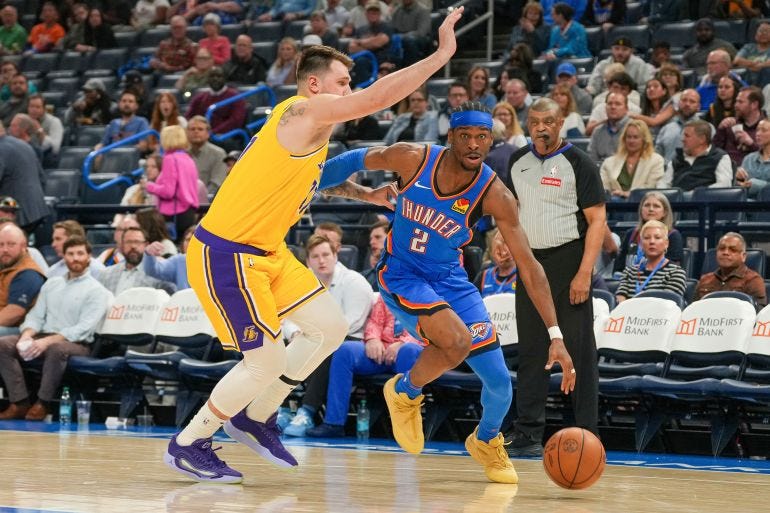
2. Luka Doncic: Los Angeles Lakers
No matter what shape or size Luka Doncic has come in, he has always been an offensive superstar. Over the past six seasons, he has averaged 30 points, 8.8 rebounds, and 8.7 assists on a 59.4% TS%. He’s an elite three-level scorer, shot creator, pick-and-roll maestro, and passer. Every team would love an elite high-volume scorer and an elite playmaker. In Doncic, you get both for the price of one. The one nit you could pick is that he is a high-turnover player, but even that’s kind of a misnomer. While he has averaged 4.0 turnovers per game over the past six seasons, he has shouldered a 36.4% usage rate, and each season from 2019-20 through 2023-24, his teams finished in the top ten in turnover rate, and four times were in the top five. Which raises the question, are you actually a high turnover player if your team doesn’t turn it over? What offensive weakness does Luka have? Well, outside of a hankering for liquid carbs, it would be super cool if he worked more off the ball, but who are we kidding? There isn’t a better set-it-and-forget offensive superstar in the world. Every center knows how to screen and roll, every wing knows how to catch and shoot, and when you add Luka, the offense is guaranteed to be good. Throughout Doncic’s career, much has been made of his defensive limitations. They’re real, but they’re also, frankly, absurd. He is not a good point of attack perimeter defender. Guess what, neither are the guys ranked three through 15. However, due to his size (6’7) and strength, he can easily be hidden on low usage wings and is an elite positional rebounder. Those traits don’t make him secretly an elite defender, but they make it much easier to build a solid to great defense around his instant-elite offense. Doncic is a perennial MVP candidate for a reason. He’s one of the five best players in the world.
1. Shai Gilgeous-Alexander: Oklahoma City Thunder
Unsurprisingly, the best point guard in the NBA is the reigning MVP and Finals MVP. Despite the accolades, I don’t think people fully appreciate how insane the season Shai Gilgeous-Alexander just had was. He averaged 32.7 points, 6.4 assists, 5.0 rebounds, 2.4 turnovers, 1.7 steals, and 1.0 blocks per game on a TS% of 63.7%. That’s not just Michael Jordan shit, that’s peak Michael Jordan shit. His BPM of 11.5 was second in the league to only Nikola Jokic, and it was the 15th highest ever. This was a season for the ages, and there’s no reason to believe he won’t replicate it again. His shooting splits, passing figures, and defensive metrics were all in line with his prior seasons. There’s a credible argument that Gilgeous-Alexander is the best player in the world. I wouldn’t make it, but I’d also vehemently deny having anyone else in second. In many ways, he’s a throwback. He pairs elite driving with elite mid-range shooting to absolutely dissect defenses, and while he has become a good 3-point shooter, it’s not a huge part of his game. His shot diet leads to slightly fewer explosive scoring performances, but also limits absolutely dreadful showings, which is why he has become a 31-point metronome. Even though Gilgeous-Alexander is the sixth or seventh best defender on his own team, he is still a plus on that end. Deployed in an off-ball role, he uses his length and instincts to rack up steals and blocks. The only negative thing about him is his free-throw-grifting ways, and that’s a positive from an on-court standpoint. SGA is the best point guard in the world. It’s why the Thunder might be at the beginning stages of a dynasty, and it’s why they have their first championship. If he can stay at this level throughout his prime, he’ll have a shot to go down as a top ten player of all time and challenge for the Point God title.
That concludes my point guard rankings. If you’ve made it this far, I’d love a comment on omissions and any rankings you did or did not like. A subscribe, like, and/or share would be cool.
For any inquiries about work, discussion, and the like, you can email me at nevin.l.brown@gmail.com.
Love that you included Dennis Schroder! I love NBA history.