
Playing Fast but Slow
How the Hornets and Celtics, and a few others, are defying convention

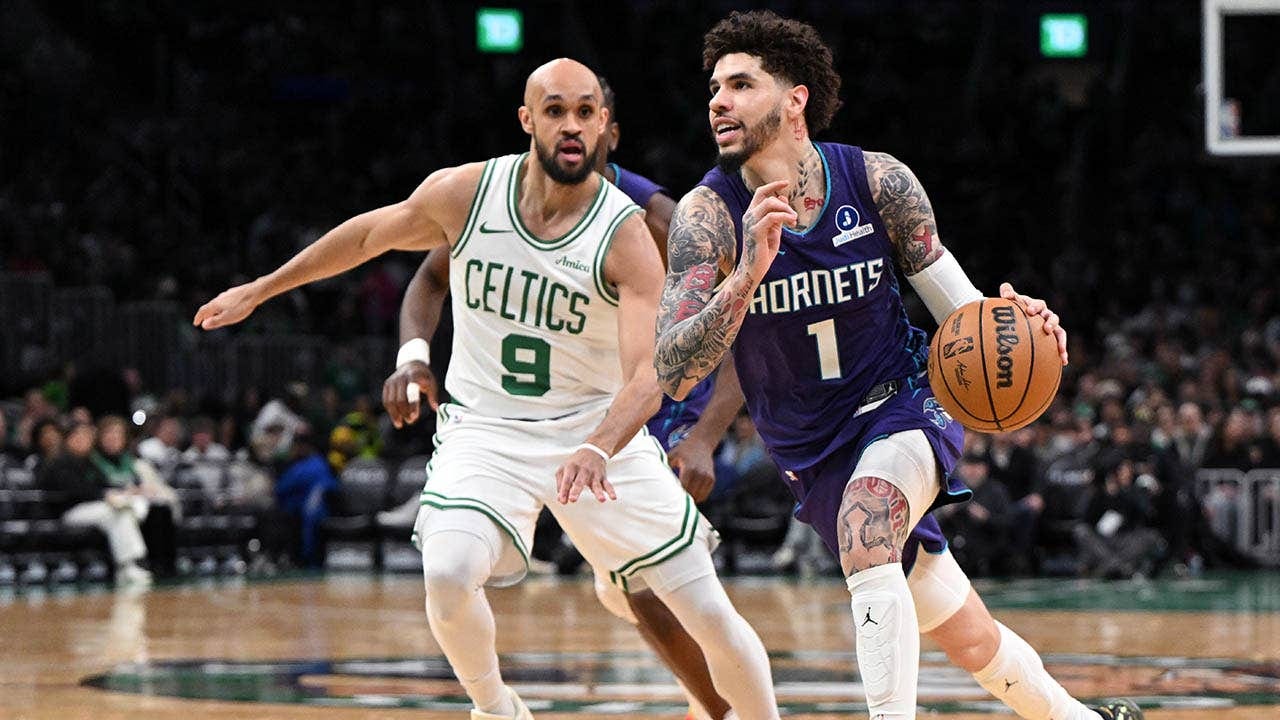
Speed and time might as well be interchangeable. A race is won by the quickest time or the fastest average speed. The difference between a 95 and 90 MPH fastball is the time it takes to pop the catcher’s mitt. The faster you go, the less time it takes for you to get where you’re going. Unless, of course, you’re the Charlotte Hornets or Boston Celtics.
Note: All data as of March 16, 2026
Thanks to the proliferation of tracking data, there is more publicly available information than one person could reasonably sort through. NBA.com has average speed and distance, Inpredictable has average time to shoot, and I had the desire to see how those two things relate because something caught my eye.
The Charlotte Hornets, who feel like they play a million miles per hour, play at one of the league’s slowest paces. Their 97.3 possession pace ranks 25th in the league, and is a full two possessions below the league average. Based on the eye test, this felt off, but I knew it wasn’t– how could it be? To make sure I wasn’t going crazy, I pulled up the average offensive team speed leaderboards and saw the Hornets at 4.66 MPH and eighth in the league. While it was good to know I was still mostly sane, I was presented with another reality-shattering dilemma– do speed and pace not go hand in hand?
Instead of simply using pace, I wanted a more granular measure, so I settled on average time to shoot. Is it better? I’m not sure, but seconds and MPHs feel like they should go together– because science! Fortunately, the relationship between a team’s pace and average time to shoot on offense is quite strong, with a -0.888 linear correlation. Considering pace takes into account defense in some capacity, it’s an incredibly strong fill-in.
When I compared every team’s average team speed on offense and average time to shoot on offense, two things became readily apparent. The first: the faster a team plays, the lower their time to shoot, with a linear correlation of -0.74. However, the second thing that immediately stood out is that a few teams have completely destroyed that notion.
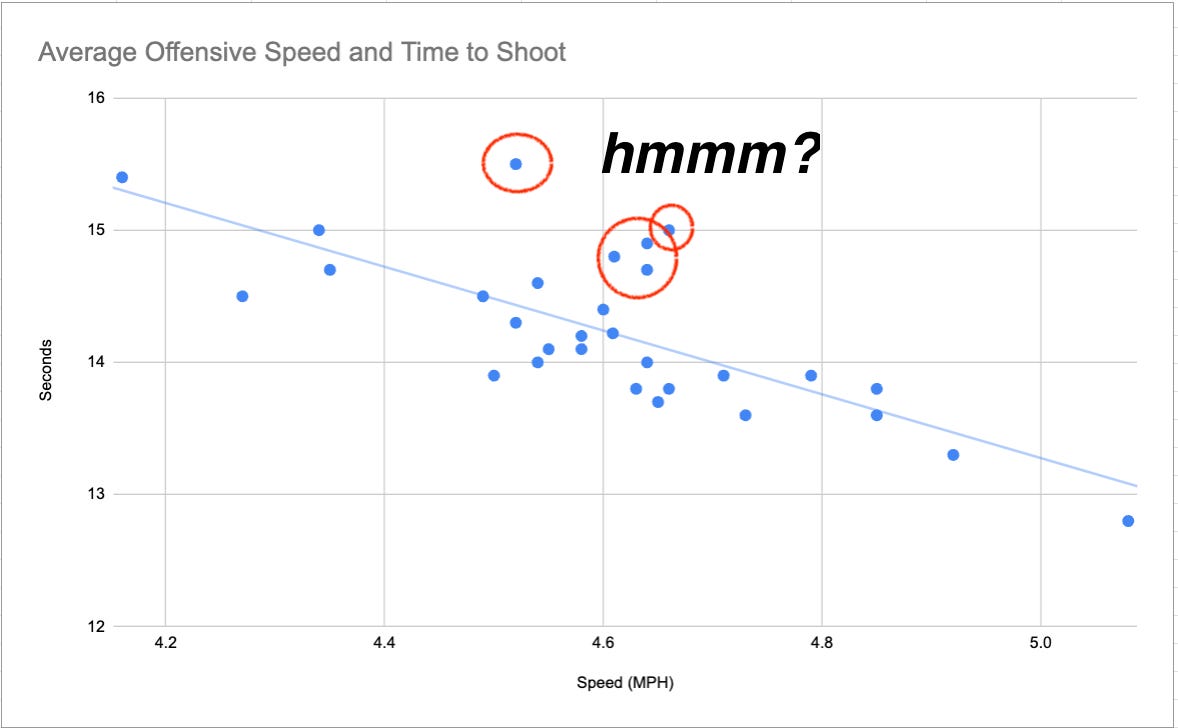
While most teams are incredibly close to the trend line, the five circled teams are defying expectations and playing much slower (seconds) than their speed (MPH). Unsurprisingly, the Charlotte Hornets were one of those five circled outliers. They had the eighth-fastest average speed on offense (4.66 MPH), but were 27th in average time to shoot (15 sec). However, they weren’t alone in this matter. The Boston Celtics take the longest to shoot (15.5 sec), but have a relatively normal average offensive speed (4.52 MPH).
To better capture how much of an outlier these two teams were, I decided to find their average speed and time to shoot in relation to the league average. From there, I simply found the difference between the two and created a leaderboard of some sort.
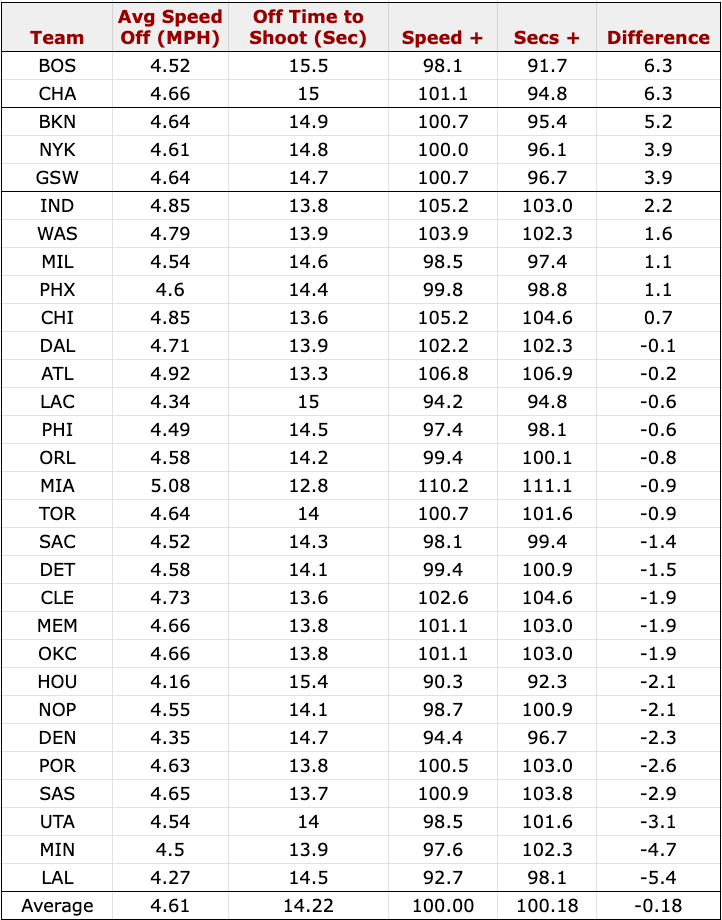
The Hornets, Celtics, and, to a lesser degree, the Nets are in a league of their own when it comes to playing incredibly fast, in comparison to how long it takes them to shoot. Obviously, there’s nothing in the rules of basketball that should prevent that, but it is certainly outside of the norm.
What is interesting, at least to me, are the coaching connections between the teams in the top five of this leaderboard. The Hornets are coached by Charles Lee, who worked under Joe Mazzulla as an assistant, which is about as obvious a connection as you’ll find. Considering the Celtics have been an elite offense, and the Hornets are now as well, we’re probably going to see more Mazzulla-ball imitators.
In my estimation, the Joe Mazzulla offense appears to have reduced Mike D’Antoni’s seven-second offense down to first principles. Playing fast, with space, and taking good shots doesn’t mean you have to shoot early in the shot clock. In fact, shooting too early takes away offensive rebounding opportunities and makes defending more difficult. When you factor in how adept teams are at generating open threes, even late in the shot clock, probing for longer than seven seconds is probably a good idea, so long as you have the requisite offensive talent.
Once again, there is a pretty obvious coach throughline for the next three teams: the Nets, Knicks, and Warriors. Jordi Fernandez, head coach of the Nets, was an assistant under Mike Brown, first with the Nigerian National Team, and then with the Sacramento Kings. Mike Brown, the Knicks’ head coach, was an assistant under Steve Kerr, and Kerr, well, he’s the head coach of the Golden State Warriors.
Stylistically, these teams don’t appear to have too much overlap, but that’s probably due to differing talent bases. The Nets are rebuilding and have been throwing rookie guards to the wolves like a pagan sacrifice. The Knicks have a ball-dominant guard in Jalen Brunson, although they have scaled back his usage this season. And the Warriors have the perpetual motion of Steph Curry to break defenses. However, clearly, the idea of moving on offense in search of great shots is at the core of their offensive identity.
While I think this could be the direction NBA offenses head, I think it’s more likely that it highlights the incredible offensive diversity we now have. If you look at the bottom of that list, populated with teams that shoot much quicker than they move, there are plenty of elite and well-thought-of offenses. The narrative that basketball had and was becoming too homogenized was never true, and I hope these charts underscore that. Remember, there are a million ways to get a bucket.
For any inquiries about work, discussion, and the like, you can email me at nevin.l.brown@gmail.com.