
Let’s Read the Trade Leaves
3 trends that will define the NBA trade deadline

If you didn’t know any better, you would have thought Tuesday, February 3rd, was the NBA trade deadline. Four trades, all including a former All-Star, were executed, and three of the four could be classified as shockers. Then, today, Wednesday, February 4th, we have been treated to three more trades, with more likely on the way. Throw in the three previous transactions of trade season, and we’re starting to get a clearer picture of what NBA front offices value, who gets moved, and for how much.
It was long prophesied that the new Collective Bargaining Agreement would curtail player movement, and in particular mid-season movement. While there was some logic to that notion, as the NBA’s new apron rules explicitly added friction to player transactions, the reality of the NBA is that no solution ever solves a problem for long. If teams can’t aggregate salary when they’re in the second apron, that just means they’ll need to make a move before the move. While there are still 24 hours for trades to flow into the league office, a few interesting trends have emerged.
Trend #1: Down Year Deals
For whatever reason, and a few are likely conspiring here, many of the players who have been moved are in the midst of a down year. Among the 14 most notable players to have been traded, on average, they have experienced a decline of 3.2 points per game, -1.3 in offensive box plus/minus, -1.5 in box plus/minus, and -3.7 in on/off rating this season (2025-26) compared to the previous three (2022-23 to 2024-25).
(Apologies if you’re reading this from a phone)
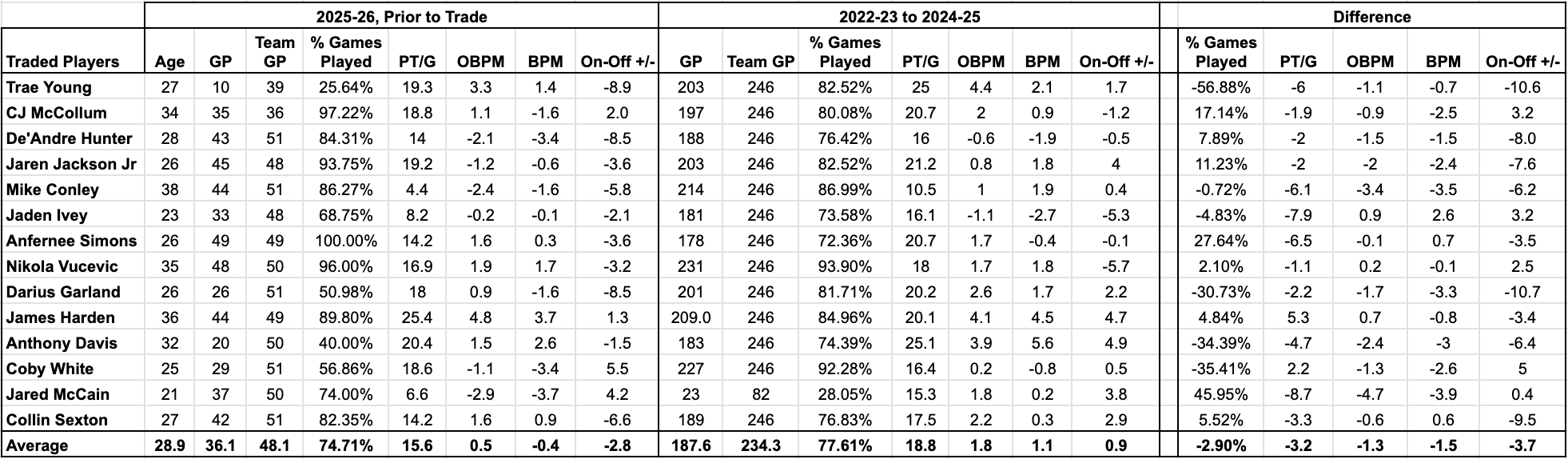
The only players on this list who improved their points per game average this season are James Harden and Coby White, and White comes with a serious caveat. In 2022-23, he largely came off the bench and averaged 9.7 points per game. Over 2023-24 and 2024-25, he averaged 19.7 points per game as a starter, which makes his 18.6 points per game a slight step back.
Perhaps the most concerning bit of data is the age profile. Eight of the 14 players are under the age of 29, but the post 30 group– old heads/uncs–, where you’d expect to see age-related decline, has actually seen their scoring dip, on average, far less than the “youngbloods.”

The senior cohort has seen its advanced metrics, OBPM and BPM, drop by more than the prime-aged contingency, but since they were starting from a higher point, they’ve been more valuable contributors this season.
Generally, to maximize a trade return, you want to move players when they’re playing well. Instead, we’ve seen a ton of teams sell very low, which gets to the next trend.
Trend #2: All About the Benjamins
Do yourself a favor, and skip the spin classes. NBA front office executives, agents, and their overly gelled media mouthpieces are going to be spinning these deals as upgrades and great trades. However, the vast majority of them are about accounting.
The Wizards were able to land Trae Young and Anthony Davis because their books were relatively clean, and the Hawks and Mavericks were not. The Cavaliers might have wanted Keon Ellis, but they really didn’t want De’Andre Hunter’s contract, much like the Kings didn’t want Dennis Schröder’s. The Celtics probably like the idea of Vucevic as a stretch-five, but they almost certainly like the $7 million, not counting luxury tax payments, in savings.
If the second and first aprons have done anything, they’ve forced teams to be more preoccupied with contract value than talent. While that might be the intention, the trickle-down effect is largely negative. Teams should be incentivized to build the best team possible at the trade deadline, not hope that a bunch of lateral moves, which cut salary, won’t hurt their chances in the playoffs.
Trend #3: Forget Firsts
Over 13 trades, a total of six first-round picks have been exchanged, and even that overstates it. The Jazz sent Memphis three firsts for Jaren Jackson Jr, but one of those is a Lakers’ 2027 first, and another is the most favourable pick between Utah, Cleveland, and Minnesota in 2027. Sure, those could become solid picks, but chances are they’re maxing out at the fringes of the lottery. While the Suns’ 2031 first is juicy, the Jazz didn’t send Memphis any player who looks like a future starter.
The Wizards also sent out multiple “Great Value” first-round picks. The 2026 first-round pick the Mavericks received for Anthony Davis is coming via the Thunder, which means it’s almost a lock to be the last pick of the round. And the other one is a 2030 top-20 protected pick via the Golden State Warriors. So, yeah, the Mavericks, at best, got the 28th and 21st pick in drafts half a decade apart, and there’s a very good chance they’ll end up with just the 30th in 2026.
Considering the marketplace, the Thunder sending the Sixers a first-round pick, along with three seconds, for Jared McCain feels like an overpay. However, once again, this first has little chance of ending up outside of the 20s. Philadelphia received Houston’s first, which is currently the 26th pick. While it’s conceivable that the pick could fall as low as 21st, it’s just as likely that the Rockets end up sending them the 28th pick.
What Does it All Mean?
I wouldn’t take too much from one deadline’s worth of activity. I think many of the moves we’re seeing are less about a shift in how organizations operate and are more a series of moves so teams can get back to business as usual. The new CBA put a premium on surplus value due to the financial and flexibility penalties placed on higher spending teams. Many of the moves we’ve seen are front offices trying to get out of or ahead of an impending financial crunch, and the best way to do that is to move on from underperforming players, relative to their salary.
Due to the fact that many of the players who have been moved were also underperforming, it’s no surprise first round picks were not flowing. I doubt this is a harbinger for a light Giannis return because Giannis is still an elite player, and you can’t fairly compensate the best of the best. Remember, Desmond Bane and Mikal Bridges were moved for five first-round picks in consecutive summers because they were both on appealing contracts.
For any inquiries about work, discussion, and the like, you can email me at nevin.l.brown@gmail.com.
Really sharp observation on the down-year pattern. The CBA's apron restrictions forcing teams to prioritize contract value over talent feels like a feature becoming a bug, teams dumping underperforming contracts instead of optimizing for playoff runs creates some perverse incentives. The age data was particuarly interesting too, younger guys declining more than the vets is unexpected.